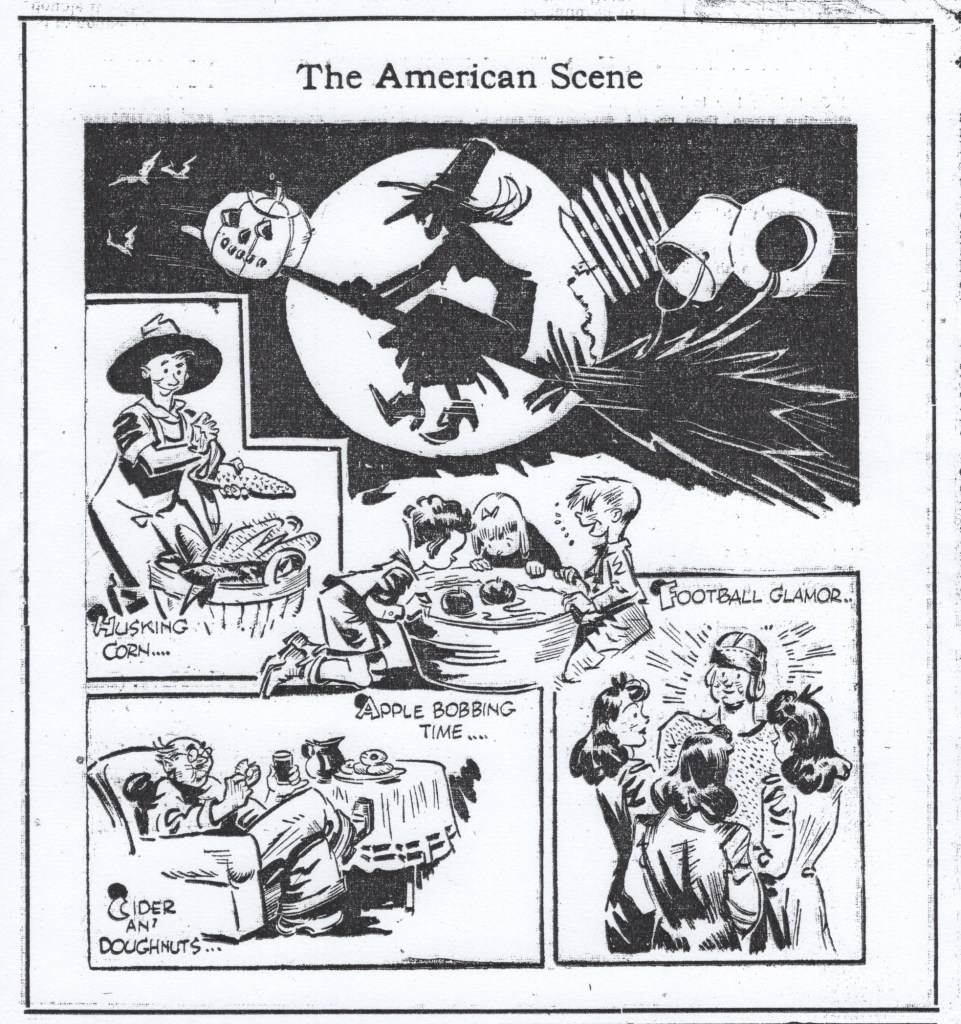
Halloween cartoon from the October 30, 1941 issue of the St. Louis Leader-Breckenridge American.
As far back as the Great Depression, Gratiot County’s town fathers deemed it important to keep kids occupied on Halloween. While a village like Breckenridge probably offered Halloween festivities before 1936, St. Louis did not hold its first community Halloween party until that year.
That Halloween in Breckenridge, the American Legion and the Professional and Business Men’s Club handed out doughnuts, cider, hot dogs, apples, and ice cream. At six in the evening, part of M-46 was closed off for a parade and races to keep young people entertained. The village hoped that giving kids things to do would prevent window soaping and property damage. It worked; they planned to do it again the next year, with Dr. Boris Zola from Saginaw performing magic. Still, in 1937, the St. Louis Leader/Breckenridge American reported that some local youths caused serious damage to the property of Mrs. Miller, an 80-year-old disabled woman. The newspaper called for those responsible to be held accountable, but it’s not clear what happened after that.
On Halloween in 1936, St. Louis held its first community party at the high school gym because of rain, drawing 350 children. The St. Louis Civic League sponsored the event, and local businessmen gave $70 for refreshments and fried cakes. They served 73 dozen fried cakes, 40 gallons of cider, 4 bushels of applesauce, and handed out 300 noisemakers. Once everyone was inside, Miss Helen Achenbach led a spontaneous amateur show. Everyone who took part got a free ticket to a movie at the St. Louis GEM Theater. The next year, in 1937, St. Louis held another Halloween party and introduced its first mask parade, starting a tradition that lasted almost 30 years.
Halloween festivities continued to grow in St. Louis over the next few years. In 1941, organizers gave out 170 dozen doughnuts, along with 2,000 cups and 2,000 noisemakers. Collections of spooks, skeletons, hobos, and Sonja Henie (a Norwegian figure skater)performed before costume judges who sat on a platform in a roped-off area of Mill Street. That year’s winners included Little Bo Peep, Goose Girl, Donald Duck, a shepherdess, and a Bowery Girl.
By 1941, Ithaca also had an annual Halloween party. One part of the tradition involved the sounding of the fire whistle to call youngsters to a bandstand near city hall. A parade then took place through the business district and ended up at the Ithaca gymnasium. Unfortunately for those in Alma, Halloween 1941 never took place, as city officials thought it cost too much money to sponsor. No one reported how many pranks were pulled in Alma that year.
Copyright 2026 James M. Goodspeed

