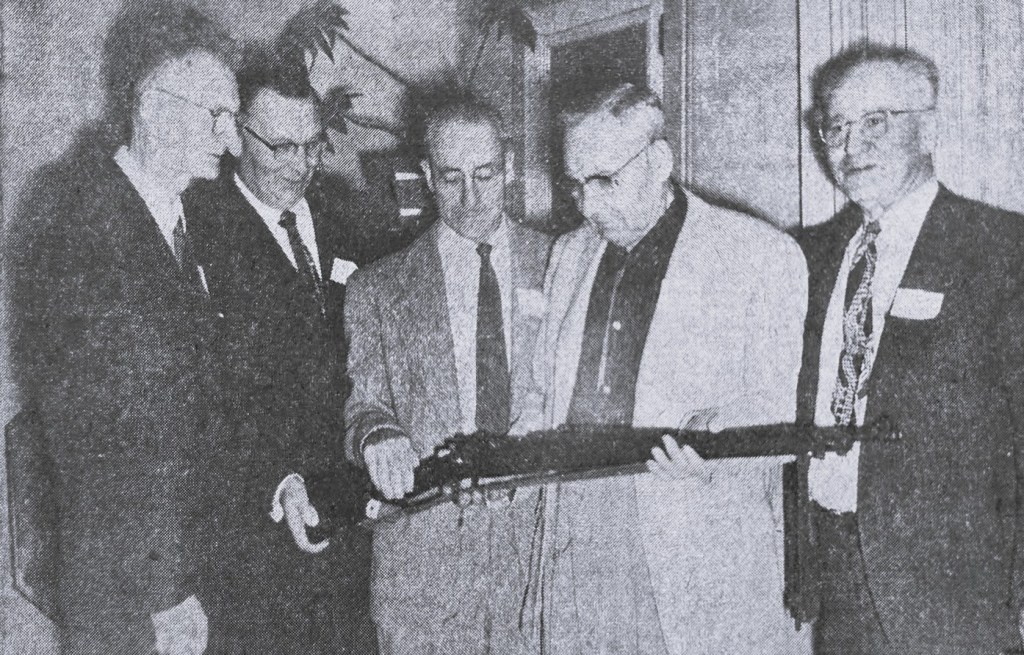
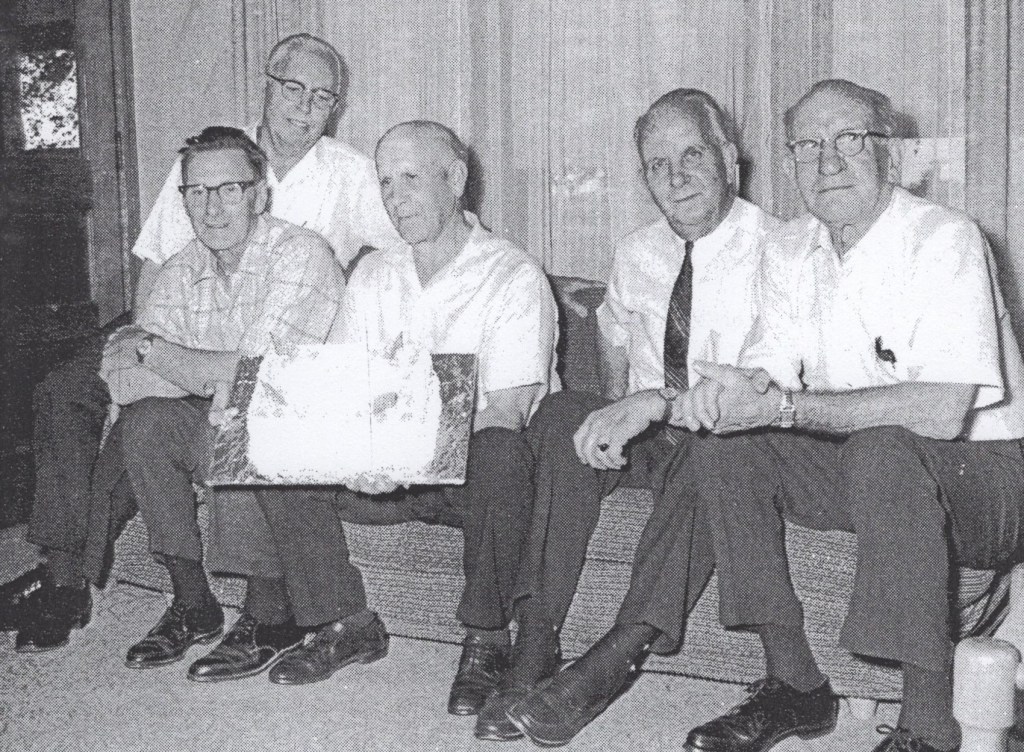
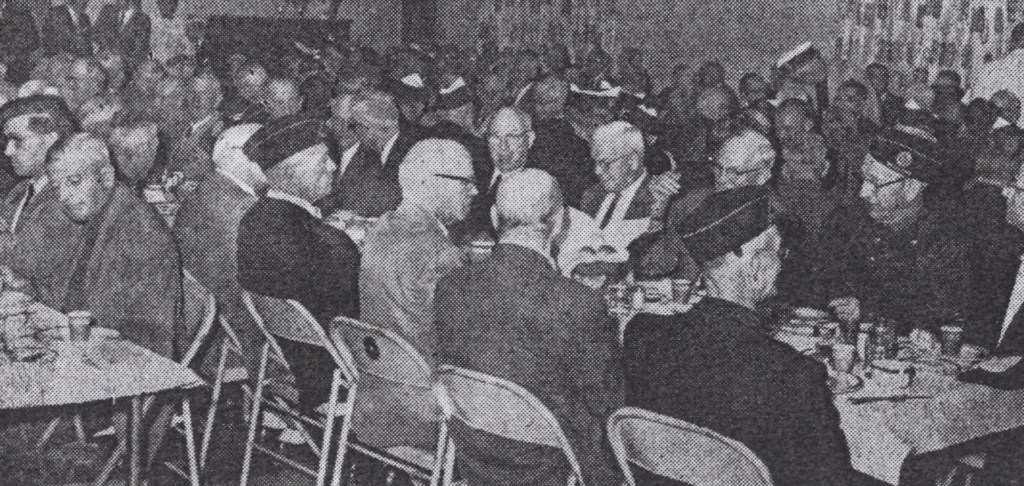
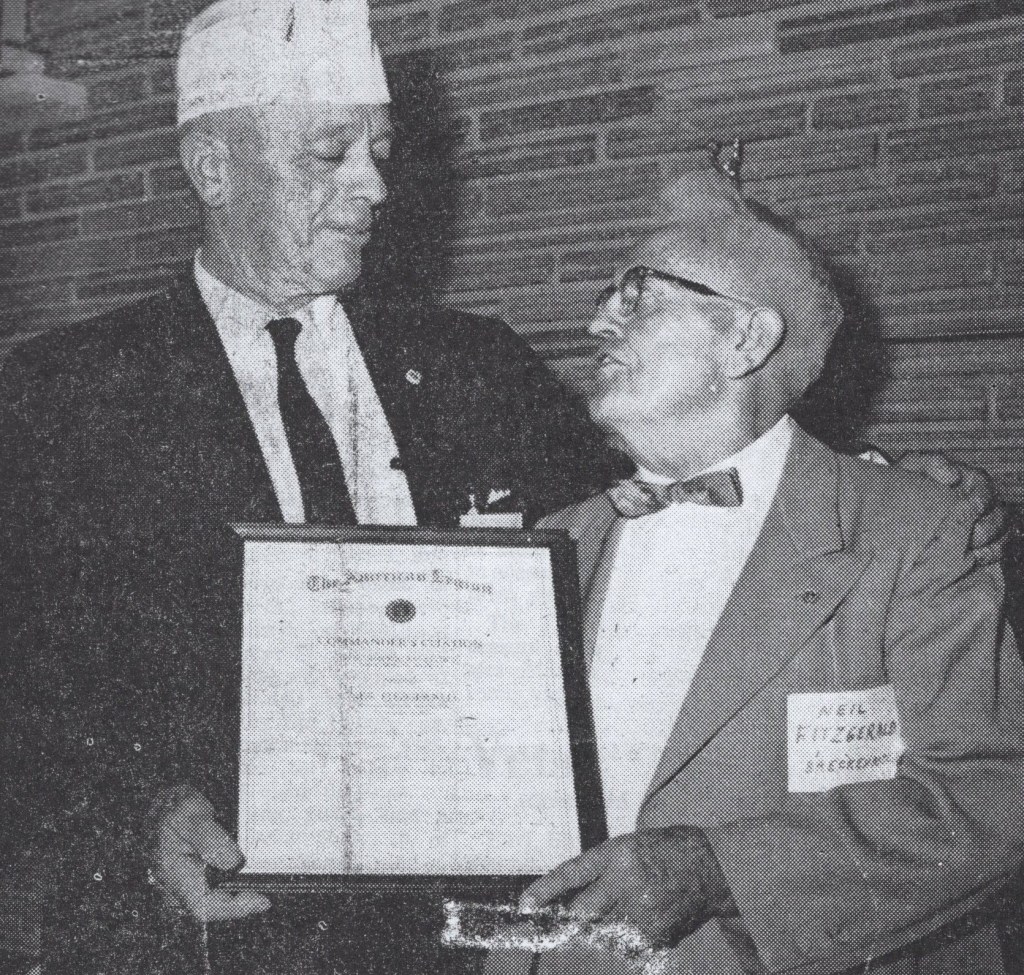
Doughboys returned to Breckenridge and kept returning from the late 1950s until the early 1970s. The annual reunion took place at the Breckenridge American Legion Hall. From the top: Cliff McKellar (far left) was instrumental in starting the reunions. Early Rhynard, Edward Baker, Clarence Frump, and Herbert Kennett inspect a WWI-era rifle; Ithaca’s Aubrey Mellinger hosted his own reunion of fellow veterans who came from across the state in the summer of 1967 at his home; More than 150 veterans came to the 1962 Armistice Day “stag” dinner; Another Breckenridge man who was instrumental in keeping the veteran reunions going in Breckenridge was Neil Fitzgerald (right), who was recognized in 1963.
Most of them first answered the call to defend Gratiot County in 1917. However, decades later, they met in Breckenridge to remind Gratiot County that they once fought in the World War. From 1956 through the early 1970s, these Doughboys came together annually to remember and remind others about what they knew as “Armistice Day.” These Breckenridge World War I reunions also were partly a response to the new national holiday, now called Veterans Day. For these veterans, nothing compared to the World War, and many had seen or witnessed the worst of it.
The idea for a reunion of World War I veterans came to Cliff McKellar, a well-known Breckenridge druggist who trained troops in Chicago during the war, as the fiftieth anniversary of the war’s end approached. McKellar’s idea of holding an annual reunion continued for nearly fifteen years and was the only one of its kind in Michigan at the time. Neil Fitzgerald, another Breckenridge veteran, served as co-chair with McKellar over the years, and the reunions were held at the Breckenridge American Legion Hall. After its start, the World War veterans came to Breckenridge – in growing numbers.
Usually held the Saturday before Veterans Day, these reunions featured a “stag dinner” hosted by the American Legion auxiliary. The event frequently included a guest speaker, updates on pension laws and veterans benefits, and film and music from World War I. As the reunions progressed, veterans from World War II and Korea were also welcome, as long as they brought along a World War I veteran. In 1960, 125 veterans from 40 communities across the state attended. A year later, the number rose to 171; in 1962, 200 attended. In 1963, 225 veterans came to Breckenridge; it was the largest turnout of Doughboys to date, as they squeezed into the American Legion Hall. In fact, as the fiftieth anniversary of Armistice Day approached in 1968, attendees had to be limited to 200 because of space constraints.
Smaller Doughboy reunions and get-togethers also took place in Gratiot County outside the larger Breckenridge reunions. As far back as the 1940s, Gratiot County Barracks No. 1094 periodically met for dinner. So did a group of five veterans from the 310 Trench Mortar Battery of the American Expeditionary Force of 1919, who met at the home of Aubrey Mellinger of Ithaca in June 1967. This small group, all from different parts of Michigan, first met at Camp Custer in November 1917. Nine months later, the men shipped out for France, where they saw action at the very end of the war in the Toul Sector. In March 1919, the men sailed home aboard a converted cattle ship.
Remembering their service, the five met at Mellinger’s home and recalled the day the Armistice was announced in France. Prior to the Armistice, one of the men recalled hauling ammunition and 155 mm shells, then fell asleep in his bunk after working nonstop for nearly two days. Someone later tugged on that Doughboy’s pants and announced the fighting had officially stopped. While loading shells a day earlier, the men saw three airplanes emerge from a cloud and several parachutes open – two were French pilots. Another object fell from the sky – a German photographer who was killed by machine gun fire and fell 4,000 feet to his death. These Americans recalled other scenes, like grey-haired French soldiers marching home along roads from the front. They also saw French civilians who began their long trek from places like Belgium and had not seen home in over four years. By Christmas 1918, Aubrey Mellinger’s unit moved into an abandoned German dugout that the German Crown Prince had occupied and then quickly left, complete with food, running water, and a piano. This group of veterans, probably like those who met in Breckenridge in the 1960s, also weighed in that day on their feelings about the war in Vietnam.
By the early 1970s, the age and health of Michigan Doughboys took their toll on the Breckenridge reunions. One of the last Breckenridge reunions, in 1970, featured Agnes Harsen, a World War I nurse, who came to Breckenridge along with 130 veterans. Sadly, within a year or two, the reunions ended, and Gratiot County’s World War I veterans continued to fade into history after fighting what they knew as the Great War.
Jim Goodspeed is the Gratiot County Historian and has worked with Fulton Schools for nearly forty years. Goodspeed is a Teacher Fellow with the United States Holocaust Museum and will soon publish his first book, “Finding Wobbelin.” He also publishes more Gratiot County history on Facebook under “Gratiot County History Time Machine.”
Copyright 2026 James M. Goodspeed

