Wayback Wednesday: Gratiot County Remembers Gold Star Mother Ella Smith, 1930

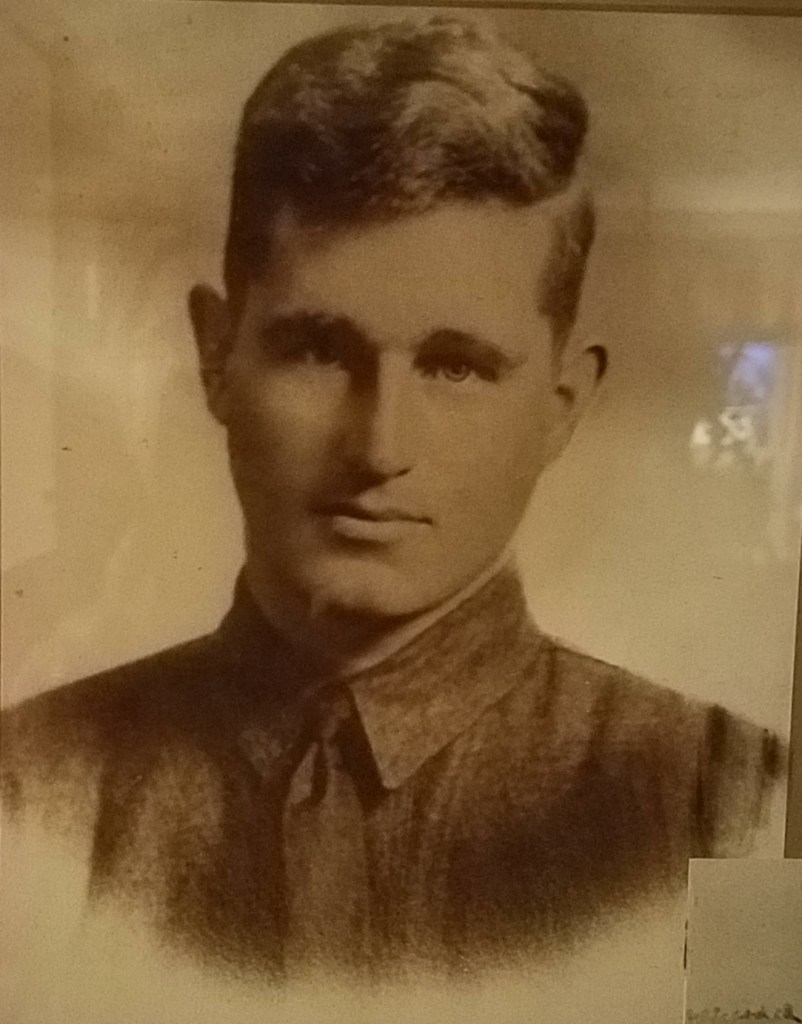
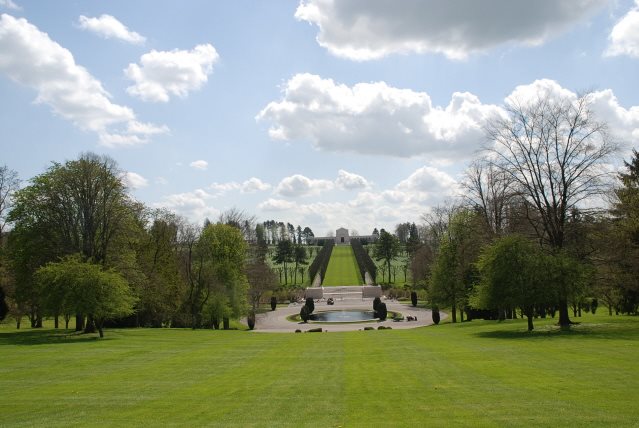
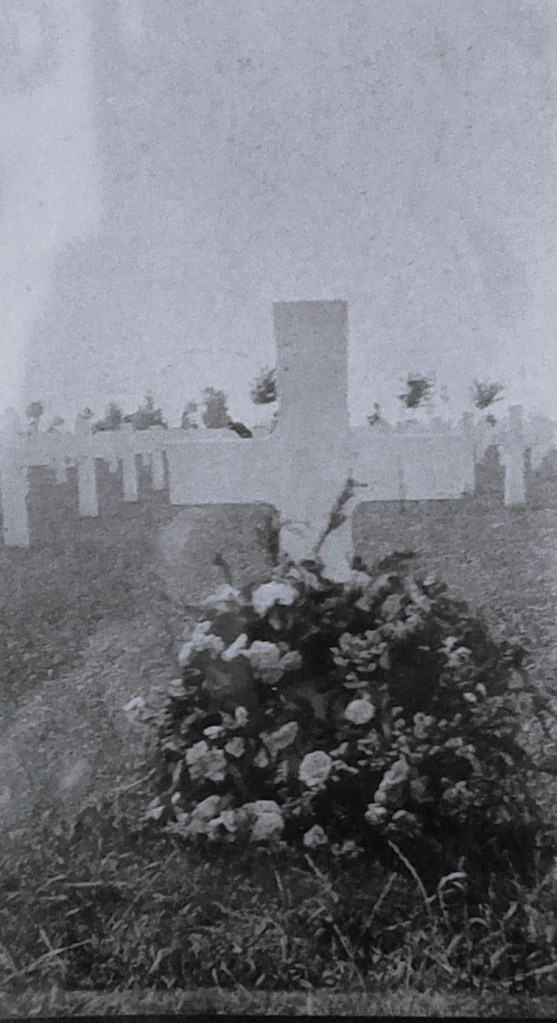
Above: Ella Smith of Perrinton was Gratiot County’s only Gold Star Mother who traveled to her son’s grave in France in 1930 as part of a government program; Private Lyle Smith was one of thirty Gratiot County men who died during World War I: Meuse Argonne Cemetery as it looks today; Private Lyle Smith’s grave on the day Ella visited the gravesite; Marker for Lyle Smith as it appears now in Fulton Center Cemetery in southern Gratiot County’s Fulton Township.

“Every marker is of the whitest marble, and they take such wonderful care of everything. I do not think I ever felt worse in my life than when I knelt by Lyle’s grave and placed a beautiful wreath of roses on it. Had a good cry, then felt better. Felt as if I had been to a funeral.”

              So wrote Mrs. Ella Smith of Perrinton, who in 1930 was Gratiot County’s only Gold Star Mother to visit the grave of her son, one of many who died on the battlefields in France during World War I. The Gold Stars were mothers and widows of those men who died serving our country.

              By the end of President Calvin Coolidge’s administration in 1929, legislation encouraged mothers to travel to France to visit the graves of their sons or husbands who had not been sent home after the war. Over 17,000 women were eligible for this fully paid trip provided by the government. By the fall of 1933, an estimated 6,693 women made the journey.

               Smith left Gratiot County in early June, 1930 and was transported to France aboard the S.S. President Harding along with 2,026 other war widows. She met women from fifteen different states; forty were from Michigan.    

              In Paris, Ella Smith and other Gold Star Mothers were placed in hotels based on which cemetery they visited. In this case, she was one of 112 women headed for the Meuse-Argonne Cemetery. Part of the trip included seeing the best and worst of post-war France. Visiting memorials, churches, and cultural sites was easier than viewing some scenes in the countryside. There, French women pushed two-wheel carts, led their horses, while seeing constant images of destroyed woods along the shell-torn countryside. 

              On June 17, 1930, Smith arrived at the cemetery. After participating in a tea service, the women were given the section number where their son or husband was buried. Upon arriving at that row, an officer gave a wreath to place on the grave. The government also had a photographer present to photograph each woman standing next to the grave. The Gold Stars then had six hours to spend in the cemetery.  

              Upon leaving, Smith’s group headed to the nearby area of the Argonne Forrest where Private Lyle D. Smith died. She wrote, “I presume I am now on land where Lyle was around the cemetery, for here is where the 26th Division was stationed.” As part of the Sixth Division, he had been there on September 26, 1918, when he sent his last letter home. He was killed October 4, just over one month before the Armistice was signed.

              Today, the base of Lyle D. Smith’s marker in the Fulton Center Cemetery reads, “Buried in France.”

Copyright 2026 James M. Goodspeed
“A Desire to Learn and Serve”: Eliud Sanchez, Gratiot County’s First Mexican-American Soldier to Die in Service

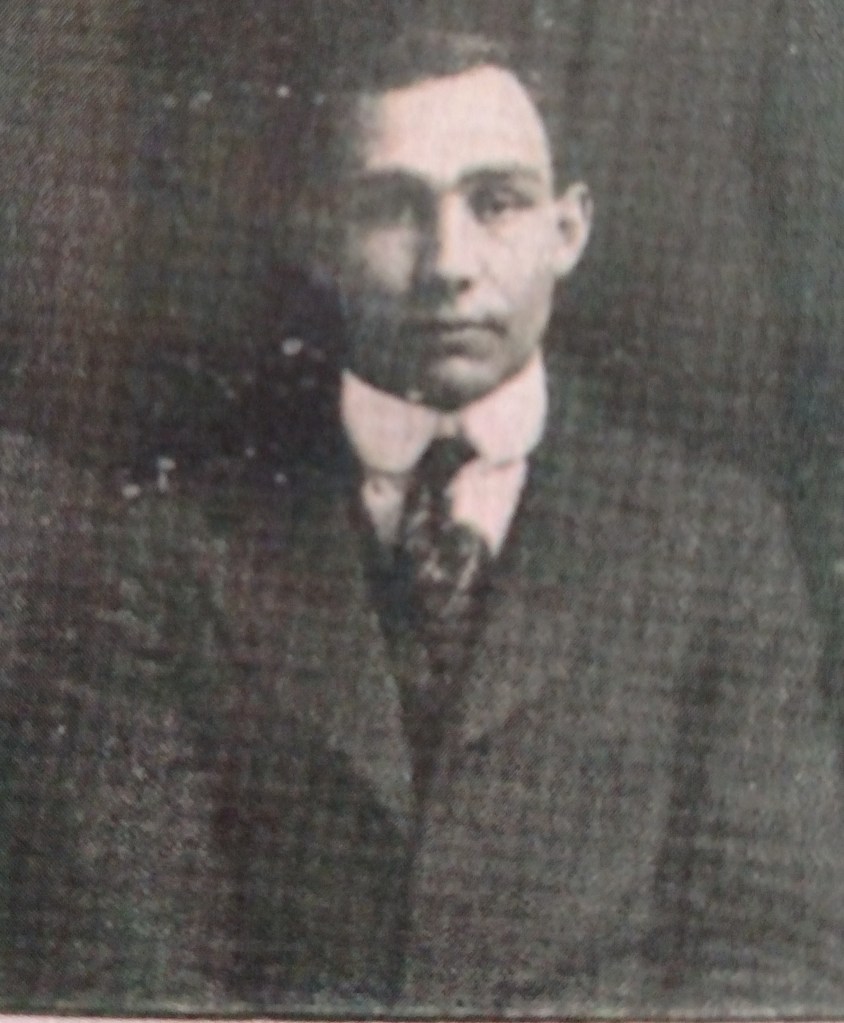
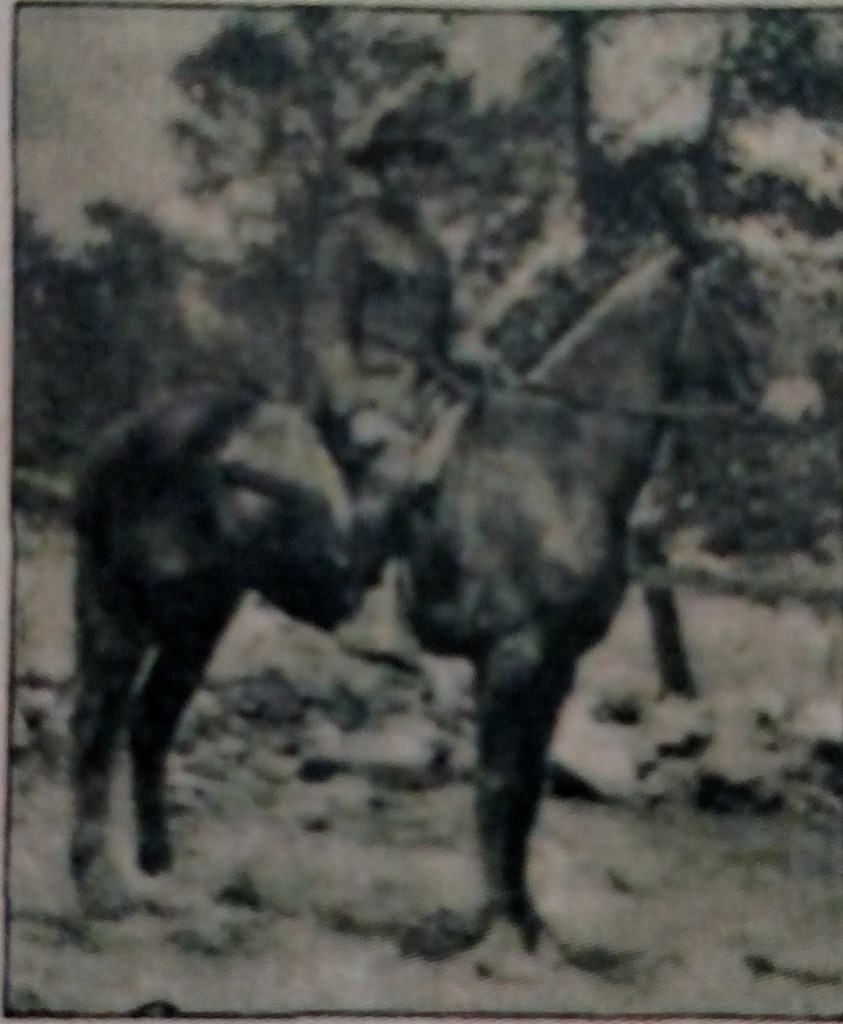
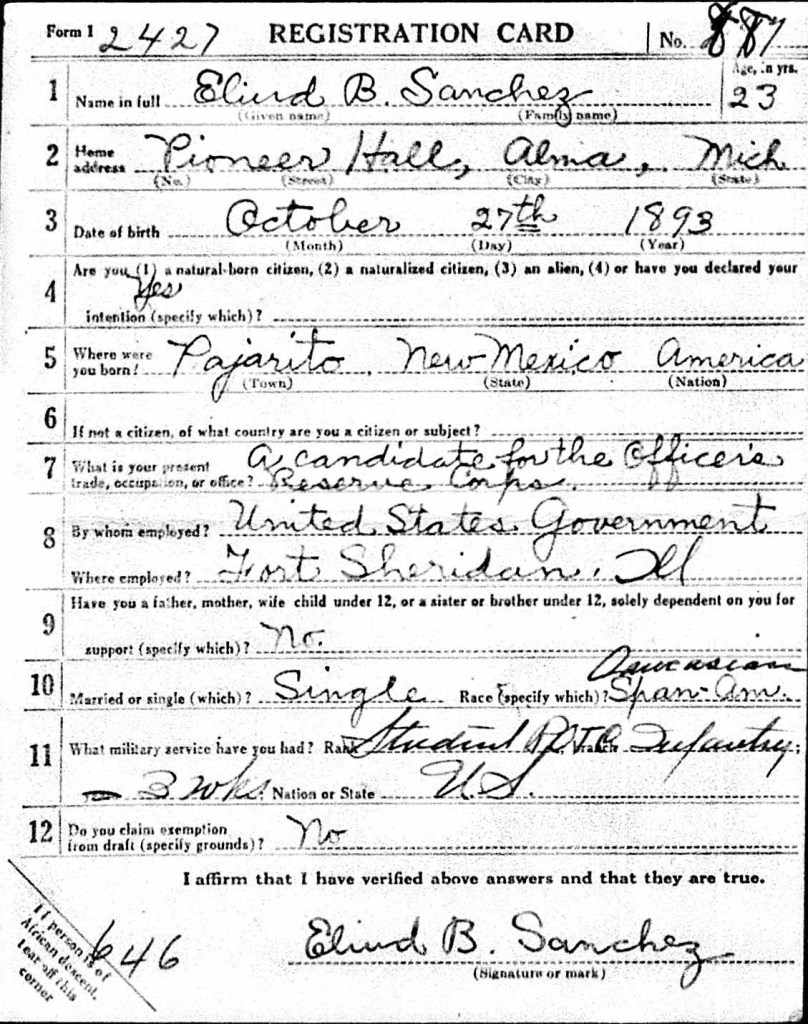
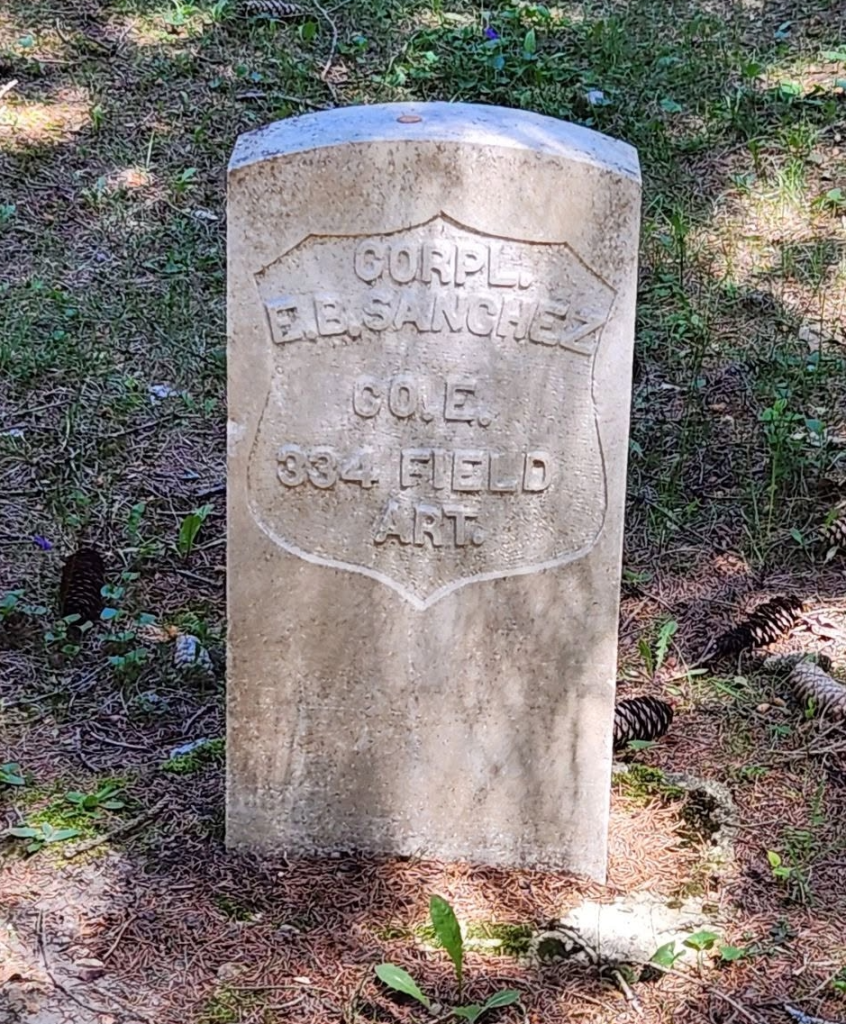
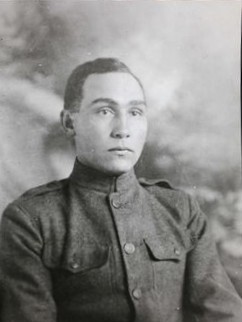
Remainders of a life of service: Eliud Sanchez’s induction photograph; a blurry photo of Sanchez atop his horse, probably at Fort Dix; two photos of Sanchez during his years at Alma College; Sanchez’s World War I registration card. He greatly desired to serve as an officer; marker for Eliud Sanchez in Alma’s Riverside Cemetery.

He only wanted to finish his studies at Alma College and become a civil engineer. When the country went to war, his biggest goal was to become an officer and fight in France. Today, his marker sits alone in an isolated spot in Section D in Alma’s Riverside Cemetery. His name was Eliud B. Sanchez, and he was the first Mexican-American soldier to die for Gratiot County.

Eliud B. Sanchez was born in Pajarito, New Mexico, in October 1893. Both parents died when he was young, and his brother, Patricio, helped raise him, along with other brothers. In 1907, Eliud was admitted to the Menaul School in Albuquerque, New Mexico, a Presbyterian boarding school founded in 1896 for Spanish-speaking boys.

In 1914, Sanchez graduated, and a year later, he came to Gratiot County, Michigan, to attend Alma College. Who helped him to make that decision, and how he got here is a mystery. At the time of Sanchez’s trip, Gratiot County, like many rural areas in Michigan, began to experience a growing need for migrant farm workers after the United States entered World War I. Farmers welcomed migrant workers, but with the idea that they would return to the South at the end of the harvest season.

Someone at the Menaul School saw promise in Sanchez and knew of Alma College. Even though the young man arrived in Alma without a penny, a place to stay, or a job, Eliud was eventually hired as the custodian at the Alma Presbyterian Church. Over the next three years, Sanchez became interested in astronomy and public speaking and was one of 35 members of Phi Phi Alpha Literary Society. One of the speeches he gave in a contest at Alma College was entitled “The City with the Soul.” Yet in most of his other classes, Eliud Sanchez was average at best. He appeared as a student who wanted an education and worked very hard at it, even though he had low grades.

After the United States declared war on Germany, Sanchez volunteered and left Alma College with another student to join the Army on May 13, 1917. Sanchez’s new goal was to become an officer, go to France, and fight the Germans. The Army sent Eliud to Fort Custer, then to Camp Pike, Arkansas, and finally to Camp Dix, New Jersey. By the time of his last assignment in the summer of 1918, he was a non-commissioned corporal and still had not made it to France. Was this because he had not finished his education? Other Alma College students had entered combat and were fighting in France. Or, was it because he was Mexican-American?

Still, Corporal Sanchez awaited going to France as a member of Battery E, 334th Field Artillery. On a warm summer day, August 20, 1918, Eliud was at a lake near Fort Dix, New Jersey, when he drowned in a swimming accident. No explanation or details about his death exist. Learning of Corporal Sanchez’s death back in Michigan, Dr. William H. Mason of Saginaw paid for Sanchez’s burial. Why Mason paid for the burial is unclear. Was Mason an Alma College graduate, a friend of Sanchez, or just someone who came forward to give a fallen soldier a proper funeral?

Upon Sanchez’s death, a photograph of him atop his horse appeared in the college newspaper, the Weekly Almanian, along with a comment that Eliud was remembered at Alma College as being “earnest, smiling, simple-hearted” and was now one of the college’s Gold Star soldiers. In 2013, a letter surfaced in New Mexico, written by one of Eliud’s brothers shortly after Eliud’s death, along with a photograph, the first since World War I.

Starting in 2017, I wrote biographies of the 30 men from Gratiot County on the Ithaca All-Wars Memorial who died in World War I, in remembrance of the war’s centennial. When I later found Sanchez’s resting place in Riverside Cemetery, I was moved by the marker’s location, as no one is buried within 10 feet of Sanchez. His location reflects the solitary life of a young man who worked and studied hard, desired an education, and wanted to serve his Gratiot County as an officer during World War I. Over 500 biographies of Gratiot County’s men and women, written by Fulton students and one teacher, can be found on Facebook at “Understanding Service – Remembering Gratiot County’s Veterans.” Also, “Thirty Who Dared to Serve Gratiot County in the Great War” can be found here at https://goodspeedgratiotcountyhistorical.blog and tells the stories of 30 men who died serving Gratiot County during World War I.

Copyright 2026 James M. Goodspeed