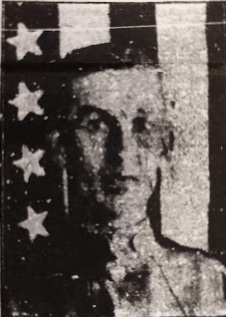
Thirty Who Dared to Serve Gratiot County in the World War – Part 25: Ralph Sawvel from Breckenridge, “I was an Alma College Student Who Chose to Go Off to War”

IMG_6461.JPGIMG_6459.JPG

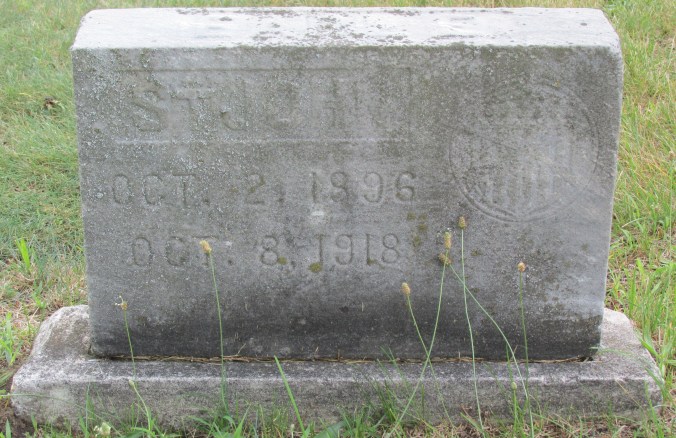
Above: The resting place in Breckenridge’s Ridgelawn Cemetery for Ralph W. Sawvel.


         Ralph Warren Sawvel was born August 15, 1897, in Breckenridge, Michigan to Robert and Almeda Sawvel. In 1910, Robert and Almeda resided in Bethany Township on a farm along with their five children. Ralph was the middle child and second son in the family. Ralph’s mother died in 1911 and his father soon remarried.

          A graduate of Breckenridge Schools, Ralph went on and attended Alma College from 1916-17.  Because of his personality, fellow students nicknamed him “Smiles.” On  July 24, 1917, Sawvel entered Fort Wayne in Detroit, and he was a Private in Company H of the 125th Medical Department, 32nd Infantry Division. From there, he was sent to Camp McArthur, Texas on October 15, 1917, where he served until January 1918 when the Army sent him to Camp New Jersey. Sawvel sailed for France in early February 1918.

           In the Fall of 1918 word reached Breckenridge that Ralph Sawvel had been severely wounded during fighting that summer. One report stated that he had been injured in late July, another in late August. Another story said that another Breckenridge boy, Ward Doyle, had helped to pick Ralph up and to see that someone cared for his wounds. Although newspapers never explained how severely he was injured, Sawvel was hospitalized. It also said that because of the severity of his injuries, Sawvel was expected to be sent home in October. Tragically, it turned out that he died in a hospital in 1919 in Brest before being transported back to the United States. Newspaper reports read that he died “from wounds received in battle. (Sawvel) carried these wounds for some time and was on his way home at the time of his death.”

          It would not be until late July 1920 that Ralph Sawvel would finally return to Breckenridge. He became the first of all of Gratiot County’s war dead to be brought home. After he arrived in Breckenridge, a short service took place in the home of his grandparents. The Breckenridge American Legion conducted the funeral and Sawvel was laid to rest in Breckenridge’s Ridgelawn Cemetery.

              At the time of this death, Ralph W. Sawvel was twenty-one years old.

Copyright 2018 James M Goodspeed

Thirty Who Dared to Serve Gratiot County in the World War- Part 24: Clyde Hull, “I Never Met my Daughter and I was Among the First to Come Home”

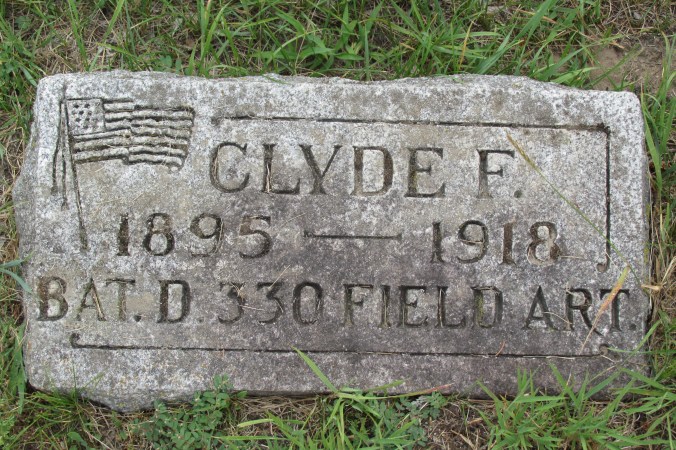
IMG_6488.JPGIMG_20181216_212929848.jpg005251429_04110 - Copy.jpg

Above: Clyde Hull’s marker in North Star Cemetery; news article from August 12, 1920 issue of the Gratiot County Herald; Hull’s registration card.

         Clyde Franklin Hull was born June 25, 1895, in North Star to Frank and Fannie Hull. By 1900 the Hull family had moved to Bengal Township in Clinton County and family included siblings Jessie, Orpha, and a brother Dillis. Clyde’s father was a farm laborer, and the family probably lived in Saginaw County at one time.

       On March 14, 1918, Clyde married Marie Nass in Ithaca, and they moved to Saginaw, where Clyde worked as a glass worker. Part of Clyde’s tie to Gratiot County was that Marie was from Washington Township.

       Clyde registered for the draft in Saginaw Township, and he was drafted on June 28, 1918, into the Army. The Hulls had been married for just over three months.  Clyde ended up in Camp Custer where he was a Private in Battery D of the 330th Field Artillery, and he sailed for France in July.

      Clyde was like a few other Gratiot County men who went to France and then contracted pneumonia and died, probably in the wake of the Influenza Epidemic. Sadly, his death came on November 27, 1918, just over two weeks after the Armistice was officially signed. Even more tragic, Marie Hull found out about her husband’s death a few days after the birth of their daughter, Lois.

         Records do not tell us much else about Clyde Hull except that he was unique among the others who died in France: he was the first to be sent home. In late August 1920, his body, accompanied by Private Baird of Company C of the 13th Infantry, came to Ithaca. The funeral took place at the Ithaca Presbyterian Church, and six Ashley men who served overseas in France served as pallbearers. He was laid to rest in the North Star Cemetery.

          Clyde Hull was twenty-three years old when he died in France.

Copyright 2018 James M Goodspeed

Thirty Who Dared to Serve Gratiot County in the World War – Part 23: Dwight Von Thurn of Alma, “He was Conscientious and Caring and He Gave His Life Helping Others”

IMG_6418.JPGIMG_6419.JPGvon thurn page 1.jpg

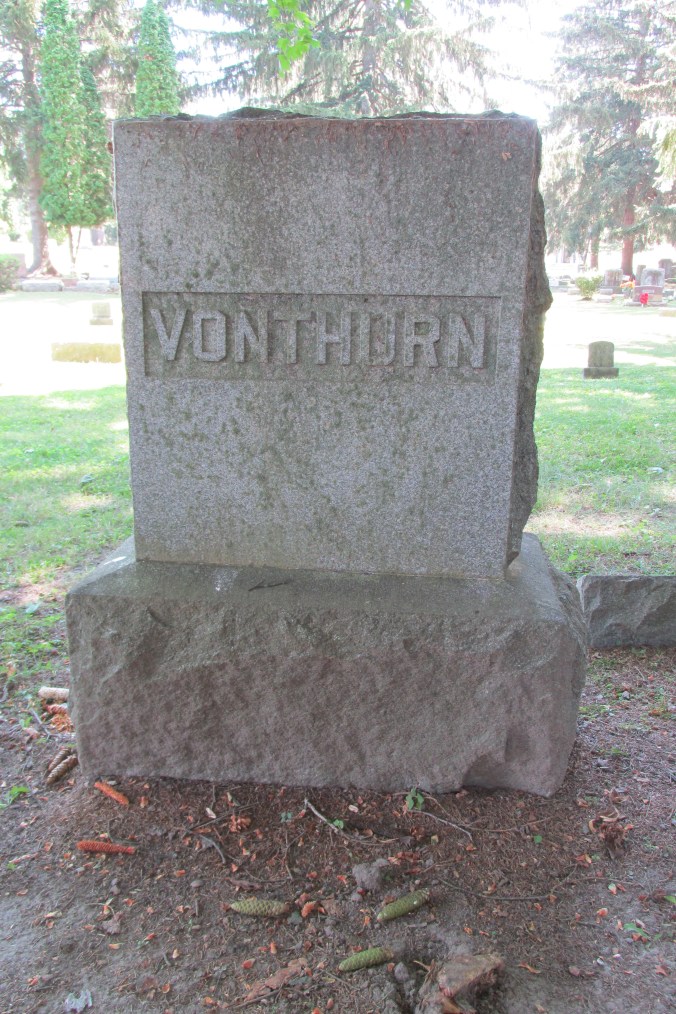
Above: Von Thurn Family plot in Alma’s Riverside Cemetery; Dwight Von Thurn’s headstone; his registration card for the 1917 draft.

         William Dwight Von Thurn was born April 30, 1894, in Helena, Ohio to Jacob and Lydia Von Thurn. They had a total of seven children with Dwight being one of the youngest. The family experienced tragedy when the oldest daughter, Bessie, died in California in 1909. By 1910, the Von Thurn family moved to Pine River Township in Gratiot County where they farmed.

        At some point, Dwight decided to attend Alma College which he was doing when he answered the call for the draft on June 5, 1917. His family suffered another loss when Jacob, Dwight’s father, died in February 1918. A month later, on March 5, Dwight left for the service and was assigned to Fort Oglethorpe, Georgia. Von Thurn entered the Transportation Corps in Motor Ambulance Company Number Two, but the Army transferred him to the Medical Corps where he became a corporal.

      When the flu epidemic reached Fort Oglethorpe, Dwight was among the first to volunteer to care for the influenza patients because there was a shortage of nurses. In the process of nursing other sick soldiers, he contracted the virus and became very ill. A call went out to his mother and sister in Alma that he was gravely ill and they rushed to see him. Sadly, Dwight died shortly before his family reached him.

          About to be promoted to sergeant, Von Thurn’s superior officer wrote about him that “He was one of the most conscientious, more than willing men I have ever had under me and his influence for good over the men about him was very great. He was an artist by nature and his horror of bloodshed so great that to take life, even of an animal, would hurt him for days and yet he conquered it all and gave his life willingly for his country.”

          Von Thurn’s body, along with his mother and sister, arrived back in Alma, along with a brother, Captain Lester Von Thurn, who also had been stationed at Fort Oglethorpe. A private funeral took place in Alma’s Riverside Cemetery. Six other men from the Alma Company of reserves attended the ceremony. The Alma Presbyterian Church, which Dwight attended, added another Gold Star to the service flag that it displayed.

          When Dwight Von Thurn died, he was only twenty-six years old.

Copyright 2018 James M Goodspeed


Thirty Who Dared to Serve Gratiot County in the World War – Part 22: Clarence Ludwick of Breckenridge, “I was a Newlywed, I Made it to Europe and Pneumonia Took Me”

7399-2-5-0-0052.jpg

104617449_1466036210.jpg

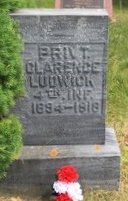
Above: Clarence Ludwick’s picture upon entering Camp Custer; his grave in Ridgelawn Cemetery in Breckenridge.

        Clarence Ludwick’s story of service for Gratiot County in World War I was memorable as he was among the first of Gratiot County’s men to die of repercussions of the Influenza Epidemic while serving overseas. Up until his death, most of the young men from Gratiot who died from the flu did so at Camp Custer or some other camp inside the United States.

       Ludwick was born in 1896 to Carson and Nora Ludwig in Breckenridge, Michigan. Clarence was the youngest of seven children, and his father was a farmer in Breckenridge. While Clarence answered the call to register for the draft on June 5, 1917, he was not called to serve until May 29, 1918. It is possible that his status as the youngest son of a farmer, who probably did not have other children at home to help with the farm,  kept Clarence from going off to the Army any earlier.

         On February 9, 1918, Clarence married his wife, Nona, in Breckenridge. He was married for barely four months when called to the service. A note in the Alma Record that “rumors here are to the effect that several of the men drafted from this county last month have been made members of the 85th Division to fill vacancies and that they will be going overseas within a few days. One of these men is Clarence Ludwick.”  Clarence entered Camp Custer and became part of Company C of the 85th Division. On July 23 he left from Brooklyn, New York aboard the SS Vestris. His papers showed that he became part of the 340th Infantry.

         Soon after arriving in France, Clarence wrote a letter home to his wife. Dated August 28, 1918, he told his wife that he was fine and having a good time. He also said that he had been transferred to the Pioneer Platoon. The way houses and barns were attached seemed strange, and some of the buildings looked like they had built in ancient times. Also, the streets were crooked and narrow, and a nearby castle covered a city block. There were no buggies, only two-wheeled carts in operation.  Strangely,  French women went out to work along with men. Here in France, he drilled two hours less each day than he did while in Camp Custer, Ludwick lamented that he had been separated from other Breckenridge boys that came with him to France and this made him feel lonely.  It also appeared, even in early August 1918, that the war with Germany could not last much longer, or so Ludwick believed. The letter was probably the last contact that he had with his wife and family in Breckenridge.

         Tragedy came on October 17 when he succumbed to pneumonia at Base Hospital #56 in the Marne. While Ludwick’s death was listed as pneumonia, many American men in France at this time contracted Influenza, then frequently stabilized or recovered. After this,  they experienced a secondary infection and died from attacks of pneumonia. This may have happened to Clarence Ludwick.

          Because Clarence had recently married and listed his wife as the one to be notified if he died, Nona Ludwick was the one who corresponded with the War Department. After the war ended, in January and then again in March 1919, Nona Ludwick asked for a picture of her husband’s grave. She also wanted to know if his body could be sent back home because she had heard that the Army was burning the bodies. If so, she wanted Clarence to remain there.

        It would over two years later, however, that Clarence Ludwick did come home to his wife. On February 14, 1921 (Valentine’s Day) the War Department informed Nona that her husband’s body was being sent to Breckenridge. Within four days of notification, Clarence Ludwick returned home and was laid to rest in Breckenridge’s Ridgelawn Cemetery.

        Clarence Ludwick was 22 years, 11 months and  7 days old when he died in France.

Copyright 2018 James M Goodspeed


Gratiot County During the World War, December 1918: The Aftermath of War

IMG_20181212_194204131.jpgIMG_20181212_194152533.jpg

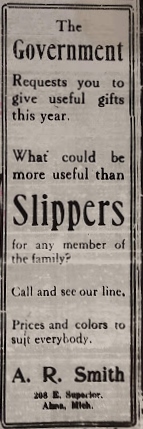
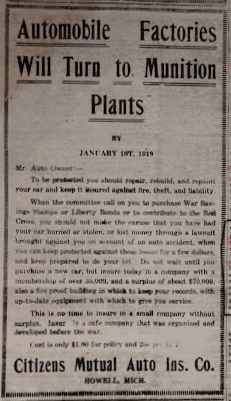
Above: Advertisements from December 1918 issues of the Alma Record

Note: This is the last in a series of articles about Gratiot County during World War I. This series chronicled the people, events, and news that took place just before the United States declared war in April 1917 and ends with Armistice.

        It was December 1918. Gratiot County had been a part of the World War for almost 20 months, and the war had finally ended. The county had been ravaged by the terrible Influenza Epidemic starting earlier in the Fall. In the meantime, the war wound down, and an Armistice came on November 11. The county celebrated America’s victory overseas and now the nation – and Gratiot County – started to wind down and turn to postwar society. Christmas was coming in Gratiot County, and people began to think of things other than war. Still, there were plenty of reminders of what this war had cost.

       Some of the last published letters from soldiers appeared in the newspapers. While a few appeared sporadically in early 1919, this was last month that they received such extensive publication.

      Bradley Stone, 141st Aero Squadron, wrote to a friend in Ithaca about seeing the damaged and scarred French countryside. A letter dated in October told how he found a downed Hun plane and what it was like to watch air battles. On one day he witnessed two German pilots land near him, thinking that they were safely inside the German lines. Upon quickly discovering their error “…up went their hands and down went their spirits.”  One German was well dressed and spoke good English. The other, more shabbily attired, “looked like a bum.” Regardless, Stone’s officers offered cigarettes and asked them questions concerning the German lines. Stone also was amazed at how much material was laying on the ground as the Germans retreated. “A person can pick up most anything in the way of equipment – guns, ammunition, scattered everywhere. The country is quite hilly and cut all to pieces.” Upon looking inside one French home, Stone could see the interior of a bedroom,  complete with pictures still on the wall and with a washstand standing against a wall. The problem was that the entire front wall of the home had been blown away.

       Walter Young wrote that he was already somewhere in Germany with the Army, twenty-five miles from the Rhine River. Mike Scott had been stationed aboard the USS Montana and was now in Germany. He thought most German people were friendly and some spoke English. He even met some Germans who had lived in the United States before the war. Corporal Percy Strouse of the 47th Infantry could not wait to return to Gratiot County and wrote to friends, “I am coming (home) to eat pie, cake and ice cream if you will make it for me. I have not seen much of either since I came across and no ice cream at all, so you see it will take a whole lot to fill me up.”

        Private John Spencer of the 338th Infantry had made it to France; however, his first stop was in Liverpool, England. While there, he visited the YMCA hut and found Miss Agnes Yutzey of Ithaca, who was a friend of Spencer’s mother.  Private R.M. Trinkham wrote to his father in Alma about serving in France with a car repair department for about one month outside of Marcy, France. While there he saw American supplies going toward the front at the rate of 25 trains a day, a record for his unit. Private Ira Williams of the 338th Infantry saw plenty of enemy Germans, “They have a lot of German prisoners here. They are a hard-working bunch.” Harold Redman reminisced about his summer trip over to England via a Transport ship. There were fifteen transport ships, two battleships, fifteen sub chasers and airplanes in this group. Redman remembered sleeping with his life preserver on at night in case the ship encountered attacks from German U-boats.  James Carter of Alma wrote that he witnessed the surrender of the German fleet while he served aboard the USS Wyoming.

      Others had more severe problems. Elwyn Follett had to be invalided home from France because he was a victim of a German gas attack and almost lost the use of one eye.  He had been in a hospital for over one month.  Private Walter Wilhelm was recovering from wounds. They were looking better – he had one in his foot, with minor injuries to a leg and his hand. “I have quit dressing all (of them) except my foot. I do not think it will be of much account, but still, it may come all right. I have a fine doctor.” He did have several aching teeth that needed to be pulled and he was soon to see a dentist. Private Earl Christy had been sick for ten days with influenza. He and his friend had recovered, and Christy was again working near the flying fields in his area. Christy sent a picture home and hoped that the Gratiot County Herald would print it. Sergeant Ted Kress wrote that he expected to be home in Ithaca very soon and planned on celebrating Christmas with the Barden family.

        In many cases, people in Gratiot County learned several months later that their son or husband had died or that they were considered missing. Part of the problem was that of over 262,000 announced casualties, only 105,000 had been reported so far by the government. Both the public and Congress pressed the Secretary of War about the rate of notification and the fact that families wanted to know what was going on with missing men.

       Oscar Narrance, an Alma College football star, was listed as missing in action. Lieutenant Charles Robinson, a former Alma College athlete, was recorded for the first time on casualty lists from the Army. Private D.R. Simmons was also listed as wounded, but not to what extent.

          Private Thomas Stitt sent word that he was in a hospital and recovering from shell shock. Carl Titus got word home that he was with the Army of Occupation in Germany. His family had not heard from him in several months. Lieutenant Edward H. Wyatt had been cited for bravery after being wounded in September while defending his platoon’s position which was under attack for an hour.

        When soldiers began arriving home, they frequently made the news. Kenneth “Dutch” Hoyt and James Barry of Alma made it home after seeing action in France.  As others made their way back over the next few weeks and months, the newspapers mentioned their returns.

         The Red Cross attempted to keep its work going and held meetings and events in different places in the county. At Pompeii, a Red Cross Lecture Cross featured Dr. Elwood T. Bailey, a welfare worker who just arrived from his work in England, Italy, and France. During his service, Bailey had encountered thousands of American soldiers. Although he talked for almost an hour and a half, his audience wanted to hear more of his address, “From Transport to Trench.”  Attendance was small, however, because of the recent fear of contracting flu. The Alma Red Cross kept busy setting up booths in the post office, both banks and the drug stores in Alma to recruit new members, instead of conducting house to house recruiting drives. The chapter hoped to produce ten serge skirts for its quota in December. Also, unused gauze was sold to the public for nine cents a yard.  Mothers and wives of deceased soldiers could obtain a “mourning brassard”  free of charge. Made of soft black broadcloth, the brassard had to be worn on the left sleeve between the elbow and shoulder. The women also spent nearly $25  at the Republic Restaurant for doughnuts for local soldiers. Recruitment for new members in Ithaca was also a goal there, even though that chapter boasted 600 members. In all events, only current members could wear the Red Cross Badge, which signified that they were in good standing with the local chapter.  The Ashley Chapter kept its rooms open and planned to work on refugee garments.

       Even though the war had been over for several weeks, there were still things happening with  “war work.” Alonzo Beshgetoor had been working at the United States Chemical Service in Cleveland, Ohio as one of one hundred chemists working on the deadliest gas yet created. Methyl was reported to be 72 times more poisonous than mustard gas. The Cleveland plant where Beshgetoor worked was producing the gas at the rate of twenty tons per day, enough to kill 650,000 men.  After months and months of food rationing and conservation, the United States Food Administration published articles of how “Food Won the War.” Still, the United States was sending 200,000 tons of food to Europe to help the people of France, Belgium, and Austria.

       Alma College was demobilizing the SATC program starting in early December. A luncheon at Wright Hall and a dance at the high school gymnasium marked its conclusion. President Crook stated that the college museum would no longer exist as a dormitory. The county also learned about the upcoming Fifth Liberty Loan Drive, which would start in the spring. The Michigan Chapter of the United States Boys Working Reserve asked Gratiot County to prepare to recruit boys to work on county farms in 1919 in anticipation of the need for more farm labor. It would be the third summer in a row that the program planned to operate. Earlier in December, Alma High School girls pledged more than $500 for the United War Work Campaign. Most of the girls would raise the money by doing work after school. Merchants and banks began to publish notices that Liberty Bonds would be accepted as payment on things like a new suit of clothes, personal loans or purchases of automobiles. These would appear with regularity over the next few years.

         Finally, there were stories about daily life in Gratiot County that December. The Idlehour and Liberty Theatres planned to reopen in December. The Idlehour had a new motor-generator installed, and Paramount pictures would run five days a week. What the advertisement did not tell readers was that businesses were waiting to reopen due to the Influenza  Epidemic. Lefty Pipp, star first baseman of the New York Americans visited Alma at the end of the month. A North Star man, “one of the meanest “ in the county, had been located and arrested for beating his pregnant wife. She gave birth while he was in jail. Walter Todd and his family prepared from Lansing to Middleton to operate the bakery there.  George Wheeler, a young Alma resident, was arrested for sending obscene matter through the United States mail. Alma stores announced that they would remain open evenings starting December 9 and do so until Christmas.

           So, that was December 1919, the last month of the World War and Gratiot County.

Copyright 2018 James M Goodspeed
Thirty Who Dared to Serve Gratiot County in the World War- Part 21: Glenn L. Heibeck, “I Wanted to Go Across to France and Do My Part”

IMG_6343.JPGIMG_6344.JPGIMG_20181209_183045633.jpg

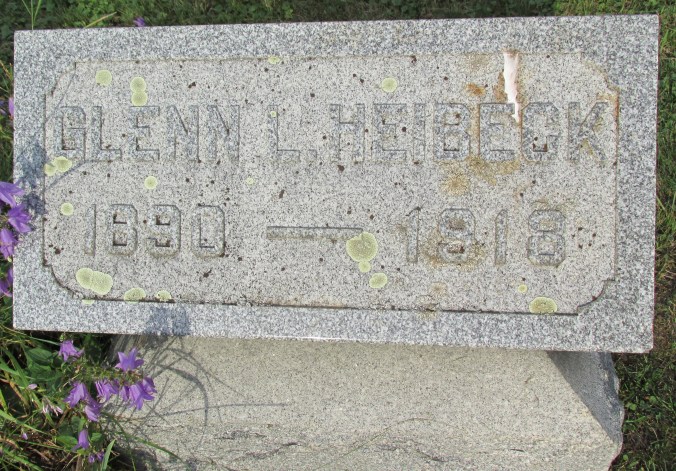
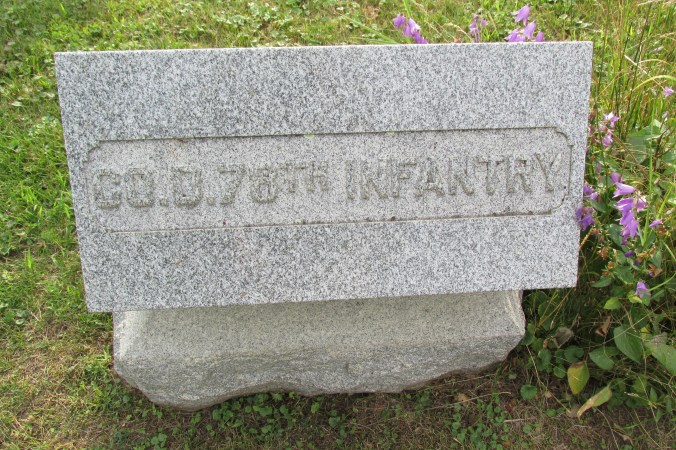
Above: Glenn L. Heibeck’s marker in the Ithaca Cemetery; photo from the Gratiot County Herald.

       Glenn Lorenzo Heibeck was born in Hamilton Township on February 24, 1890, to William and Ida Heibeck.  Glenn spent his entire life on the family farm until called to service on July 25, 1918. Glenn also had four sisters.

       Upon entrance to Camp Custer, Heibeck was a Private in Company D, 78th Infantry. He just entered the sniper’s school – a high honor for a private. His family noted that Glenn’s one wish was to get to France to serve his country during the war.

         On October11 1918, Glenn Heibeck died during the Influenza Epidemic at the camp. It was probable that Heibeck survived influenza but could not recover from a secondary attack of acute broncho-pneumonia. Heibeck was one of over 600 men who died at Camp Custer during this epidemic.

      When his body came home, his buddy from his company, Private John Halfman, accompanied it.  The funeral took place at Ithaca Presbyterian Church, and burial took place in the Ithaca Cemetery. The Gratiot County Herald noted that the Heibeck family had supported the war effort through in the fullest extent by purchasing Thrift Stamps, Liberty Bonds and by giving to the Red Cross. Now, the Heibecks had given their most precious gift, their son.

Glenn L. Heibeck was only 28 years old when he died.

Copyright 2018 James M Goodspeed

Thirty Who Dared to Serve Gratiot County in the World War – Part 20: Earl E. St. John: “I Was From Breckenridge, and My Service was Cut Short.”

IMG_6454.JPGIMG_6455.JPGSt. John - Copy.jpg

Above: Earl St. John’s marker in Ridgelawn Cemetery in Breckenridge; St. John’s registration card.

        Earl E. St. John was born on October 2, 1896, in Wheeler, Michigan to Levi and Mary St. John. Earl also had two older sisters, Ethel and Sarah. In 1910 his father was farming and renting a farm in Wheeler. Before Earl ever join the military he experienced personal hardships because his mother and both sisters died. At one point his father moved to Horton, Michigan, and Earl also lived in that area before being drafted in the late summer of 1918.

        On August 28, 1918, Earl St. John entered Camp Custer, and he became a private in Company H of the 78th Infantry.

       Less than six weeks later, Earl St. John became sick when the Influenza Epidemic reached Camp Custer. On October 8, he died from complications of broncho-pneumonia. He was pronounced dead, and the Army decided not to do an autopsy.

         Instead, St.John’s body returned to   Breckenridge. It cost his father $59.75 to have his son sent home. After the funeral took place,  Earl was buried in   Breckenridge’s Ridgelawn Cemetery, where he rests today.

Earl St. John was a single man who died just one week after his twenty-second birthday in the service of Gratiot County.

Copyright 2018 James M Goodspeed
We Remember Gratiot County and the Attack on Pearl Harbor: December 7, 1941

arizona.jpg

Pearl Harbor, December 7, 1941

Note: This article first ran two years ago in the Gratiot County Herald. I share it again with this audience In honor and memory of those from Gratiot County who served in the military, and for those who lived through this time in our history. 


              Seventy-seven years ago on December 4, 1941, it was a “Window Night” in Gratiot County, which marked the start of the Christmas shopping season in the towns of St. Louis, Alma, and Ithaca. Businesses stayed open late with lighted store windows.  That weekend at the Strand Theater in Alma, viewers watched a musical movie entitled “Chocolate Soldier.” Over at St. Louis, the Boy Scouts helped the national defense effort by hosting a paper drive.  A representative from the Public Works Reserves explained to the St. Louis City Council how they could eventually adjust from wartime to a peacetime economy. These events all took place in Gratiot County just days before the Japanese attack on Pearl Harbor. After December 7, the county, like the rest of America, was never the same.

                As news of the attack arrived that Sunday, “general indignation” best described residents as they discussed what they had learned. Within hours of the attack, a previously scheduled group of 46 selective service men left for induction at Fort Custer near Battle Creek. Starting December 8, the telephone at the draft office in Alma rang repeatedly. Men who had previously changed their addresses now notified the office about how they could be found to join the military. Some men above the age of 28, who had been previously excluded from selective service because they were too old, now wanted to know how to enlist. In the first wave of men who immediately volunteered through the Alma office, fifteen joined the Navy, twelve went into the Army, while others headed to Lansing and Saginaw to enlist there. The Gratiot County Red Cross announced the week after the attack that the county needed to raise $5,100 for the national fund. Women wanted to sew and knit for soldiers and servicemen at the Alma Red Cross office.

           Local families worried about the fate of their sons in the aftermath of Pearl Harbor. One of these involved Mervin DeMott of Pompeii, who was stationed aboard the US Dunlap. Within a week of the attack, DeMott wrote to inform his family that he was safe but he could not say more. Also, his Christmas presents had been mailed home. Marine Corporal Dale L. Peters of Breckenridge was stationed at Wake Island during the Japanese attack, along with former Ithaca resident Private Charles D. Sagash, who was at Corregidor.

                Gratiot County readied itself throughout December. Leonard and Mid-West Refineries hired extra guards and put up fences around their plants to protect against sabotage. For further protection, the companies required fingerprints and photo identification buttons for employees. The Gratiot County clerk announced a considerable demand for birth certificates took place in Ithaca because those who wanted to work in industrial plants needed one in order to apply for a job. Amateur shortwave radio operators in the county had their licenses suspended for fear of sending messages to the enemy. County firefighters underwent defense training for handling bombs and volunteers throughout the county learned how to provide basic Red Cross first aid. Lobdell Emory announced that it had received subcontracts for the defense effort, but for security concerns could not accurately acknowledge what it would be producing.

                As December ended, citizens continued united in their response to the Pearl Harbor attack. The St. Louis City Council purchased $20,000 in Defense Bonds. In Alma, twenty county men quickly joined the National Guard Unit. By Christmas, one of the first painted “V” for Victory Signs appeared in the east window of the Alma Main Cafe.

Copyright 2018 James M Goodspeed
Thirty Who Dared to Serve Gratiot County in the World War – Part 19: Edward Peters, “I was a Farmer and I Died from Pneumonia”

Peters (1).jpgCamp_mills_ny.jpg

Above: Edward Peters marker in Fulton Center Cemetery; photo of camp at Garden City, Long Island, New York.

      Edward W. Peters was born on February 3, 1898, to William and Nona Peters in Perrinton, Michigan. Edward was one of six children.  He also was a farmer just before entering the service at Columbus Barracks, Ohio on February 14, 1917.

       Peters served at places like Waco, Texas, then Charlotte, North Carolina, and finally to Garden City, New York. His last assignment had to work with the Aero (Aviation) General Supply Depot and Concentration Camp with the 614th Aero Squadron. By the fall of 1918, approximately 30,000 men were stationed at this camp. Some notable people who went through there included Douglas MacArthur and F. Scott Fitzgerald.

      On October 13, 1918, Edward Peters died of pneumonia. The timing of his death coincided with the flu epidemic and possibly Edward could have died of complications from the flu. His records tell more about his return home and the cost of his funeral, which totaled $151.90.

       Unfortunately, this is all that is known about Edward Peters, who was just over twenty years old when he died in service to Gratiot County during the World War.

            Copyright 2018 James M Goodspeed
Thirty Who Dared to Serve Gratiot County in the World War – Part 18 : Frank DePauw, “I was Foreign Born, Raised in Gratiot County, and Few People Knew Me”

Frank De Pauw.jpg55991851_138180340909.jpg

Above: the only known picture of Frank DePauw; DePauw’s grave in the Meuse Argonne Cemetery.

       Of all of those men who died for Gratiot County in the World War, there was one that died in France that we know little. His name was Frank DePauw.

      Frank DePauw was born in 1898 in Beldboon Dender Loaun, Belgium to Constance and Clementine DePauw. It is unclear what happened to his father or how and when Frank arrived in the United States, His mother lived in Detroit, and at some point in Frank’s life, Clementine sent her son to live with his two uncles, Frederick Maylaert of Ithaca and Frank Maylaert of Pompeii. These two men raised  Frank.

      Young Frank DePauw entered the draft when he lived in Pompeii in May 1918. DePauw went to Camp Custer and then left for France with the 85th Infantry Division on the SS Vestis. Soon, DePauw ended up transferring to the 4th Infantry Regiment, 3rd Division. It was while fighting with this regiment that he died on October 4, 1918, in the Meuse Argonne. One record stated it as “Death instantaneous.”

      It was a year after Frank DePauw’s death that his mother, Clementine, began to ask questions about the location of her son’s grave.  She initially wanted to have her son sent to Michigan for burial, but she stated in June 1919 that “ (I) have decided to go to Belgium and wish his body to remain in France.” At that time the government had not yet started sending remains back to the United States. A second letter,  written two months later, again asked the War Department, “Kindly let me know where my son’s body is buried in France, as I am going to Belgium, and from there to France to visit my son’s grave.” A third letter, dated August 1919 asked again where her son was at because she was soon to leave for France.

       Little appeared to happen regarding Clementine DePauw and her son until almost a decade later. In the late 1920s, President Calvin Coolidge’s administration started a program to allow the mothers and wives of those men who died in France to travel there to visit the graves. These women were a part of the Gold Star Mothers program. The government paid for the expenses of the entire trip. In June 1929, the War Department tried at least twice to locate Clementine DePauw to invite her to travel to France with the program. No response came, and she seemed to have disappeared.

       Nothing else remains about the story of Frank DePauw, his mother or his family.

      Frank DePauw was approximately 20 years old when he died during the World War in France, a young man who gave his life for Gratiot County. He rests in the Meuse Argonne American Cemetery.

Copyright 2018 James M Goodspeed