Thirty Who Dared to Serve Gratiot County in the World War – Part 18 : Frank DePauw, “I was Foreign Born, Raised in Gratiot County, and Few People Knew Me”

Frank De Pauw.jpg55991851_138180340909.jpg

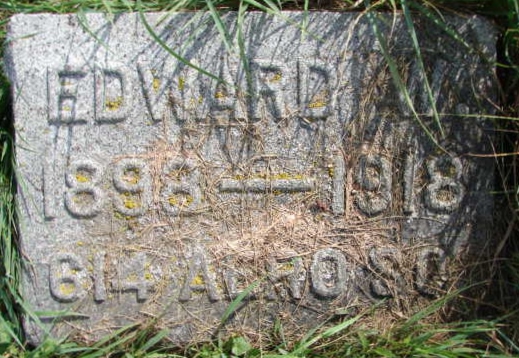
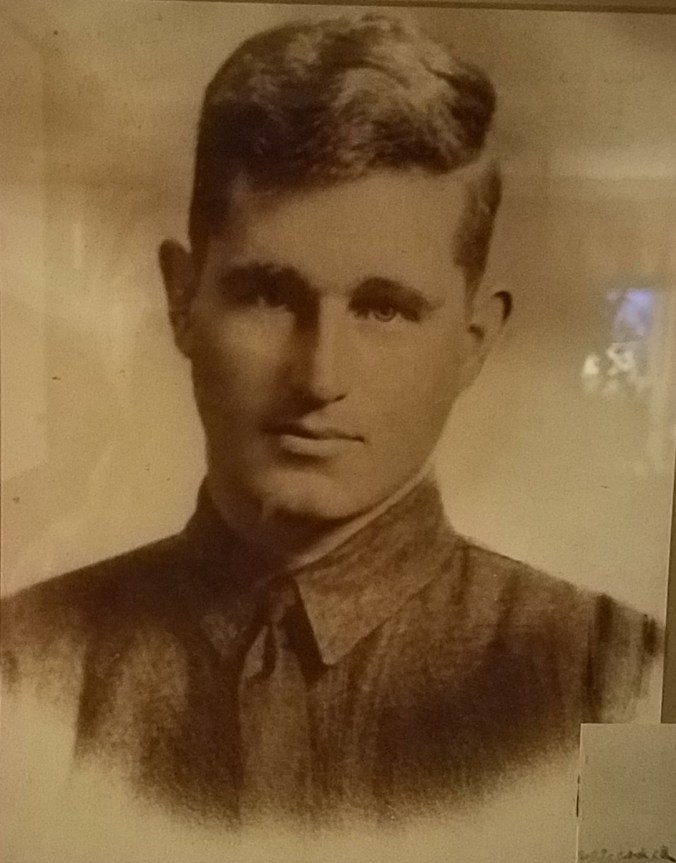
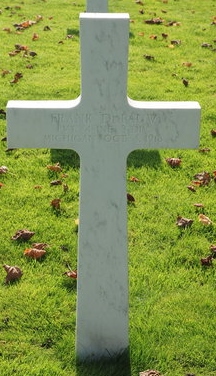
Above: the only known picture of Frank DePauw; DePauw’s grave in the Meuse Argonne Cemetery.

       Of all of those men who died for Gratiot County in the World War, there was one that died in France that we know little. His name was Frank DePauw.

      Frank DePauw was born in 1898 in Beldboon Dender Loaun, Belgium to Constance and Clementine DePauw. It is unclear what happened to his father or how and when Frank arrived in the United States, His mother lived in Detroit, and at some point in Frank’s life, Clementine sent her son to live with his two uncles, Frederick Maylaert of Ithaca and Frank Maylaert of Pompeii. These two men raised  Frank.

      Young Frank DePauw entered the draft when he lived in Pompeii in May 1918. DePauw went to Camp Custer and then left for France with the 85th Infantry Division on the SS Vestis. Soon, DePauw ended up transferring to the 4th Infantry Regiment, 3rd Division. It was while fighting with this regiment that he died on October 4, 1918, in the Meuse Argonne. One record stated it as “Death instantaneous.”

      It was a year after Frank DePauw’s death that his mother, Clementine, began to ask questions about the location of her son’s grave.  She initially wanted to have her son sent to Michigan for burial, but she stated in June 1919 that “ (I) have decided to go to Belgium and wish his body to remain in France.” At that time the government had not yet started sending remains back to the United States. A second letter,  written two months later, again asked the War Department, “Kindly let me know where my son’s body is buried in France, as I am going to Belgium, and from there to France to visit my son’s grave.” A third letter, dated August 1919 asked again where her son was at because she was soon to leave for France.

       Little appeared to happen regarding Clementine DePauw and her son until almost a decade later. In the late 1920s, President Calvin Coolidge’s administration started a program to allow the mothers and wives of those men who died in France to travel there to visit the graves. These women were a part of the Gold Star Mothers program. The government paid for the expenses of the entire trip. In June 1929, the War Department tried at least twice to locate Clementine DePauw to invite her to travel to France with the program. No response came, and she seemed to have disappeared.

       Nothing else remains about the story of Frank DePauw, his mother or his family.

      Frank DePauw was approximately 20 years old when he died during the World War in France, a young man who gave his life for Gratiot County. He rests in the Meuse Argonne American Cemetery.

Copyright 2018 James M Goodspeed


Thirty Who Dared to Serve Gratiot County in the World War, Part 17 – Lyle C. Smith: ““ I was Newly Married, I died in the Argonne and My Mom was a Gold Star Mother”

20171230_210851.jpg005251382_01932 (1).jpg16462902_127367895062.jpg

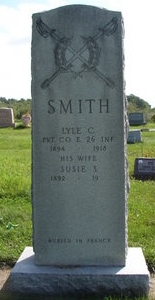
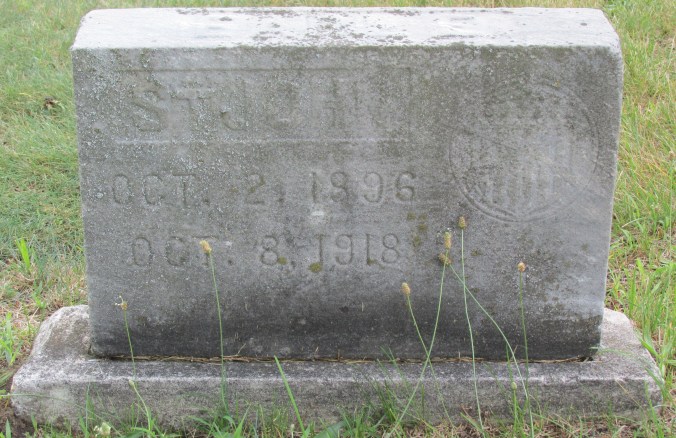
Above: Picture of Lyle C. Smith taken during the service; Smith’s draft registration paper; a marker in Fulton Center Cemetery.

      Lyle Charles Smith was born in Fulton Center on June 12, 1894 to J.D. and Anna Smith. The Smiths, who were a farming family with six children (one of whom died in childhood), experienced a tragedy when Anna died in 1907. Lyle’s father remarried Ella Winsor who became a mother to the children.

      When the United States entered World War I, Lyle entered the first draft in Gratiot County. Lyle married his wife, Susie Fraker, just four days before he left for Camp Custer from Alma on November 20, 1917. They had only a short time together before he left.

       At Camp Custer, Lyle became a part of the 7th Company,  2nd Battalion Depot Brigade. From here he was sent to Camp Merritt, New Jersey and became a part of Company E, 26th United States Infantry. Upon arrival in France, the Smith family knew little of his whereabouts except for five letters that he wrote,  all from   June 1918.

        Private Lyle Smith met a tragic end when he died in the Battle of the Argonne on October 4, 1918. Although he died October 1, his family and his wife did not know of the confirmation of his death until early December 1918. Even then, the Smiths only learned of his death through names of the dead that appeared in newspaper lists. Lyle Smith was buried on the field of battle and then moved to what became known as the Meuse-Argonne Cemetery in Meuse, France.

        Years later, Ella Smith wrote the United States War Department that “Lyle was a good son and I think I have been a good mother to him. Lyle and his father were pals, and his father has never been the same since Lyle’s death. He still mourns his son’s death. He was his father’s right-hand man.”

       However, this was not the end of the story of Lyle C. Smith and his family. In the late 1920s during the administration of President Calvin Coolidge, legislation was passed to allow mothers and widows to make the trip to France to visit the graves of their son or husband. Over 17,000 women were eligible for the trip, fully paid by the government, and some 6,693 were selected to do so for those that were considered Gold Star Mothers. Because Susie Fraker Smith, Lyle’s widow, was soon to remarry, she wanted Lyle’s step-mother to go in her place.

      Ella Smith was one of 2,026 war widows who traveled to France in early June 1930 aboard the SS Harding. During the trip to France, Ella Smith was able to visit the cemetery and Lyle’s grave.  She was given a wreath to place on the grave, and a photographer took a picture of her standing next to Lyle’s marker. Ella Smith was Gratiot County’s only Gold Star Mother to travel to France under this program.

     Some years later, a marker as placed in the Fulton Center Cemetery in Fulton Township. Toward the southern part of the cemetery,  a significant marker in that section is dedicated to Lyle C. Smith. It reads at its base, “Buried in France.”

        Lyle C. Smith was the first Fulton Township man to die in the World War. He was only 24 years old, and he left behind a widow and his family.

Copyright 2018 James M Goodspeed

Gratiot County During the World War – November 1918, Part II: The End of the War

IMG_20181129_203650920.jpgIMG_20181129_203701944.jpg

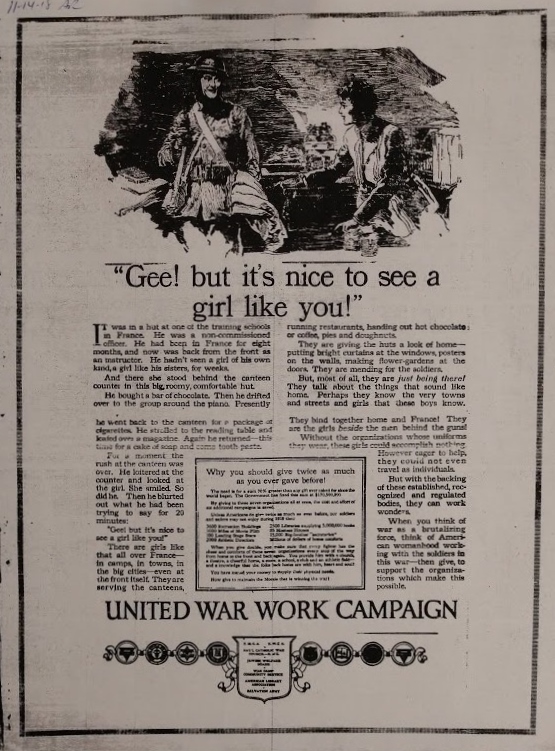
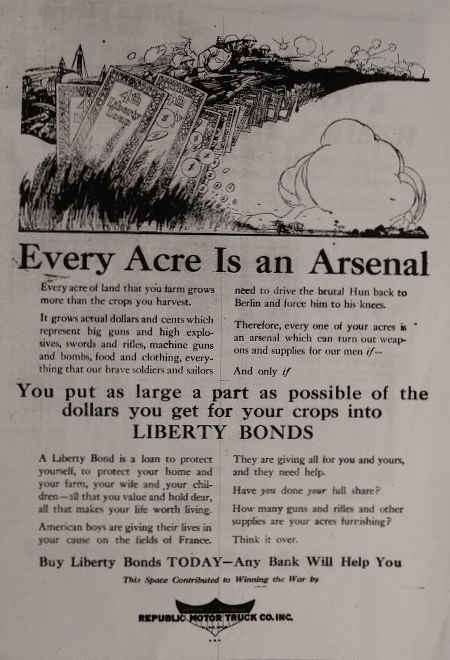
Above: War advertisements the November 14, 1918 issue of the Alma Record.

       Even though the Armistice occurred in early November, Gratiot County continued to learn about and hear from soldiers. Edwin P. Mahr wrote to an Alma woman about being in the fight at the front. He noted that every time the artillery fired on the Germans in his area a large group of the Boches found their way to his position so that they could surrender. Mahr also visited a German prisoner of war camp where the enemy was happy to eat American corn beef, coffee, and hard tack. The terrible, muddy terrain of the front was told by Private Frank Reed to his brother in Alma. Reed noted how the mud was at least six inches deep, but it was not as cold as back home. Reed could not wait to come back to the States.

          Several letters that reached the county were from the sick and wounded. Sergeant George Dolloff wrote from Base Hospital Number 28 in France. Dolloff was on crutches and was slowly recovering from his wounds. Still, he remembered the Battle of Chateau Thierry and the destruction that the 125th Infantry found when it arrived there earlier that fall. “They were not towns,” he recalled,  “just heaps of ruins of stone, brick and mortar with pieces of furniture and clothing and sometimes broken rifles and machine guns (were) lying around…” The Germans had been gone for only four hours when Dolloff managed to capture a German officer. “I want to tell you that I never felt so important in my life as I did when he was standing hands up and I was taking his guns away from him,” Dolloff wrote. Ray Belding of the 6th Infantry wrote to his mother that he was at a rest camp after fighting at the front. He was drawing $44.30 a month in pay, or about 250 francs.  Sergeant Carlos Allen wrote to his mother that during his service with the 125th Infantry he was awarded the Distinguished Service Commendation. Still, he felt lucky to have come out of the war in as good a shape as he did. Floyd Coss kept his family in Ithaca up to date on his injured leg. He had been seriously wounded and had to lay in one position all of the time in a hospital. Private Clarence Hetzman wrote to his family from Base Hospital Number 27 and declared that he did not need much – he only wished that someone would send him some candy as it was very scarce there. He also hoped that the family could read his letter as he had seriously injured his right arm and was writing with his left hand. Other news from soldiers dealt with those who had suffered from gas attacks or the flu epidemic. Lieutenant Colonel Raymond C. Turck was laid up in a hospital in France due to an encounter with mustard gas. Theron Cady, who was in the Marines, wrote to his brother that he was sick and he had been sent to the hospital. Cady was probably one of many men in France who had contracted influenza. Alma received word that Clyde McElfresh, who had been superintendent of the motor division at the Republic Truck Company, died of Spanish Influenza while in a camp. His body was sent to his home in Ohio. Verne Handley described driving trucks near Paris and then he detailed how American soldiers were buried where they fell and then how a few were being moved to the newly created cemeteries. Handley correctly predicted that many Americans would one day come to France to pay respects to these graves. Private Caroll Betts wrote back that his work at a supply base was the same that he did at the Alma Republic Truck Factory. He was lucky to have a nice wooden barracks, straw ticks, heavy blankets and creamery butter to eat – which he discovered was made in Alma, Michigan!

      Early in the month before the Armistice, a total of 57 men were called to report to the Alma draft board where they were told that they were headed to Camp Wardsworth in South Carolina.  However, when the Armistice was announced on November 11 all inductions into the United States service came to a halt. This meant that over 300,000 men who would have been sent to training camps across the United States did not have to go. Still, the Student Army Training Corp continued its program at Alma College. In other news, things did not go well for Private Albert C. Beaudry who was picked up in Alma by Chief of Police Oscar Vibber. Beaudry was listed as a deserter who left the 71st Balloon Detachment  at Langley Field in Hampton, Virginia. When the 9th Motor Supply Train prepared to leave Alma one Sunday afternoon the commanding officer thanked the women who showed up with coffee and doughnuts for the soldiers onboard.

         The Red Cross in Gratiot County that November continued to focus on the war effort, even after the Armistice was announced. Preparing shipments of Christmas packages was important to the Ithaca Red Cross Chapter. They offered assistance and shipping labels to families who were trying to send their veteran a package for Christmas.  Still, attendance levels had dropped off and more workers were needed in the hospital garment room. Over at Alma, workers were urged to come back now that the flu epidemic quarantines had ended in Alma. No official notice had been given by the Red Cross to stop work, so Alma pledged to keep going. After the first Armistice announcement, a big drum was carried through Alma’s streets to ask for donations. It garnered $65.51.  The Alma Chapter hoped that people in town would continue to give their monthly pledges. Headquarters for the winter was initially going to move to the Baptist Church, however, the chapter moved to the second floor of the Pollasky Block. Previously the Alma Red Cross had been meeting at the Alma Masonic Home. One bed comforter was still on hand for $5 and it was hoped someone would buy it, as well as an organ that needed to be sold. The Junior Red Cross also prepared boxes for Belgian and French orphans for Christmas. Over at St. Louis, the Junior Red Cross had a collection just before the Armistice that contained old rags, paper, old iron, brass, and lead. They sold it for $117.05 and donated it for Red Cross work. As November ended, the Gratiot County Red Cross had 4, 821 members and receipts during the war totaled an amount of $28, 872.08.

        And then there was just daily life in Gratiot County that November. Free moving pictures were shown at the Alma Methodist Church and people who attended were asked to pledge for the United War Work Campaign. This organization raised money for the YMCA, Knights of Columbus, Jewish Welfare Board, Salvation Army, and other groups that helped the war effort. The Model Bakery continued to sell its famous Victory Bread. A Farwell woman had been told that her husband, who died from pneumonia in a military camp, had supposedly been killed from poison that the Germans had placed in the aspirin. The rumor went around that a total of 250 men died from the poison and the story was so alarming that the government asked newspapers like the Alma Record to tell readers that no such event actually took place. Governor Sleeper asked Michigan residents to pray in church  and to give thanks on Sunday, November 17 on what he called “Victory Day.”

       Even before the Armistice, there was the continued call to conserve food. Yet, those who lived in beet sugar producing states like Michigan would be able to receive four pounds of sugar per household starting December 1.  Finally, during the November election, the Woman’s Suffrage amendment passed in Gratiot County on a vote of 2349 to 1436.

Copyright 2018 James M Goodspeed


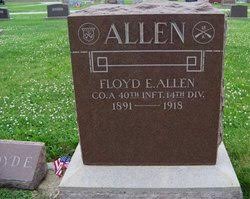
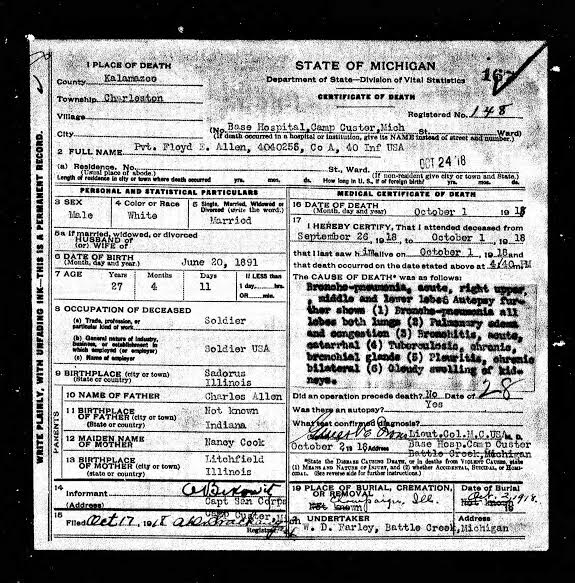
Thirty Who Dared to Serve Gratiot County in the Great War, Part 16: Floyd E. Allen, “I was the First to Die in the Flu Epidemic at Fort Custer”

2 - Copy.jpg1.jpg3.jpg

Above: Floyd Allen’s draft card; Allen’s burial marker in Illinois; death certificate from Camp Custer

       Floyd Edward Allen was born June 20, 1891, to Charles and Nancy Allen in Champaign County, Illinois. He had one younger brother and one older half-sister.  Although his father was a farmer and the family remained in Illinois, Floyd Allen’s connection to Gratiot County came through his wife, Anna, who was from Alma. On June 13, 1916, the couple married in Wayne County, Michigan.

          On June 5, 1917, Floyd Allen answered the call and registered for the draft in Alma, Michigan. At that time, Floyd and his wife were living north of Elwell where he worked for Charles Catron. Upon induction to the Army at Camp Custer, he became a part of the 40th Infantry, Company A.

          Floyd Allen met a tragic death when he became the first Gratiot County soldier to die in the Influenza Epidemic at Camp Custer. At the very end of September, the flu virus reached the camp. Over 6,000 men became sick there during October and November 1918. Of this group, over 600 died from influenza. Floyd became sick on September 26 and he passed away on October 1, 1918, at 4:40 p.m. from broncho-pneumonia in both lungs, making him among the first to contract and die during the epidemic.

       Allen’s body was returned home to Illinois where he was laid to rest in Craw Cemetery in Sadorus, Illinois. At the time of his death, Floyd Allen was only twenty-seven years old.

Copyright 2018 James M Goodspeed

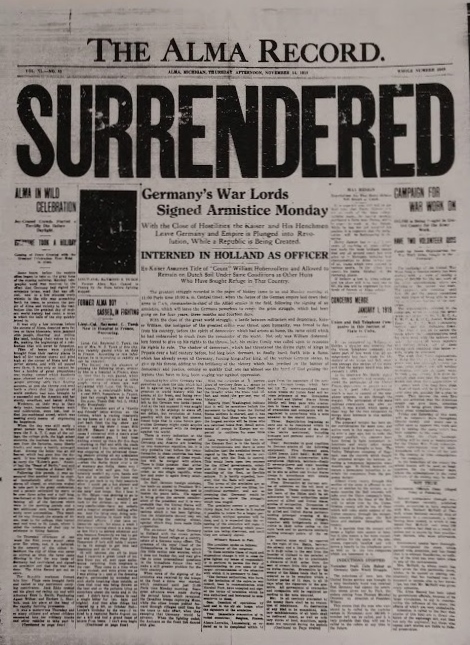
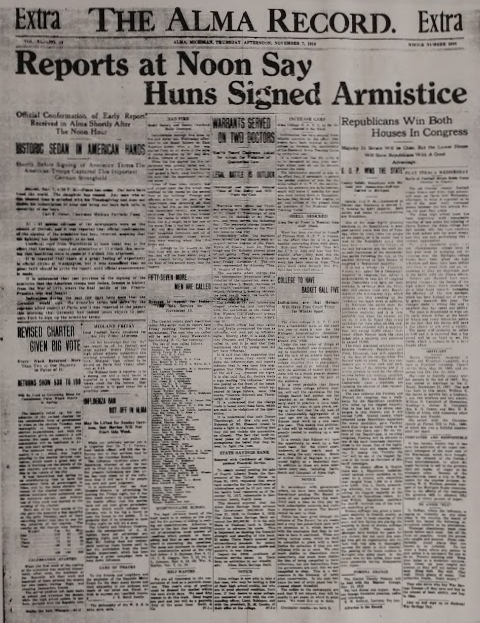
Gratiot County During the World War, November 1918: “IT’S AN ARMISTICE! The War is Over!”

AR a.jpgAR b.jpg

Above: an issue of the Alma Record published on November 11, 1918; below is the front page of the issue published one week earlier for “the false peace.”

        “SURRENDERED”  was the title of a local newspaper signifying the events on November 11, 1918, in Gratiot County.  Germany surrendered and the war that Gratiot County had fought for nineteen months was officially over – and people went wild.

        Newspapers initially said the war was over in Europe on November 7, but negotiations between the Allies and Germany would take place for another three days. “The false peace of Thursday last” was the phrase used by many at that time, but people tried to celebrate anyway. When the official peace was declared on November 11 at about 3:00 a.m.  Gratiot time, some people immediately started marking it in bigger ways. This time, schools, stores, and businesses shut down as thousands of people across the county took to the streets wherever they lived. In many places, the celebrating took place at different times throughout the day.

        In Alma, after bells and whistles went off, deserted streets that morning were quickly filled with crowds of people. Piles of boxes were located and quickly stacked on the corner of State and Superior streets to have a bonfire. Hundreds danced around the fire and people who were on their way to work got lost in these masses. Alma College students, many who were in the SATC program, joined in, as well as workers from the Liberty Truck company. An old hearse was converted to a float and then used to carry the Kaiser’s goat. Another float that came behind had the remains of the Kaiser and another went down the streets with the depiction of “the Beast of Berlin.” At noon, another parade was organized and it proved to be three and a half miles long, starting at the Republic Track Factory and wound through the town to Alma College, then it turned east and headed for St. Louis.

        Ithaca held its celebrations early that morning. Henry McCormack set off a collection of fireworks from atop the Gratiot County Herald that he had been saving for two years. Automobiles went through the streets, people shot off all types of guns, church bells pealed, children played horns, and bonfires were made by many in town.  School in Ithaca closed at noon and Mr. Struble, who owned the local movie theatre, set up his projector outside and gave a free show.

         When Breckenridge got the news, people in town could not sleep even if they had wanted to. An observer noted that “everyone was more enthusiastic and mad with joy and more noise was made then during the previous celebration.” Middleton and Perrinton celebrated with “peace parades” through their villages. Twenty-eight automobiles were in line, all decorated with flags, one with a trailer that contained the body of Kaiser and another with a riddled German flag. The Perrinton sharpshooters followed on another float, all making noise with horns, pans, and drums.  After a short program in Middleton, the caravan returned back to Perrinton. Probably this parade was tamer than the one held a week earlier during “the false peace.” Someone in Middleton at that time accidentally shot down the telephone cables and Middleton lost telephone service.

        Many over in Ashley rang bells and fired guns early that morning, but the real fun did not start until 7:00 p.m. that night on the school grounds. People there hoisted an imitation of the Kaiser up a flagpole which was then shot down. The excitement lasted in Ashley for two hours that night.

       Just across the west county line, no one in Vestaburg had witnessed such an outbreak of patriotism in that location’s history. More than one band led people through the streets, stopping at the homes of Civil War veterans along the way. Ben Corder, a Civil War veteran, played in one of the bands, using the drum he played when served during that war. A huge bonfire was held at the bank corners where an effigy of the Kaiser was burned. Rachel Kemmerling, age 87 and the mother of a local pastor, marched from her son’s parsonage down to the Ferris Church where she raised a flag up the flagpole and started ringing a bell.  No Fourth of July celebration in Vestaburg ever compared to the fireworks, dynamite, firecrackers, and guns that went off there late into the night.

      “The Great War”, “The World War” and “The War to End All Wars” was now over for Gratiot County.

Copyright 2018 James M Goodspeed


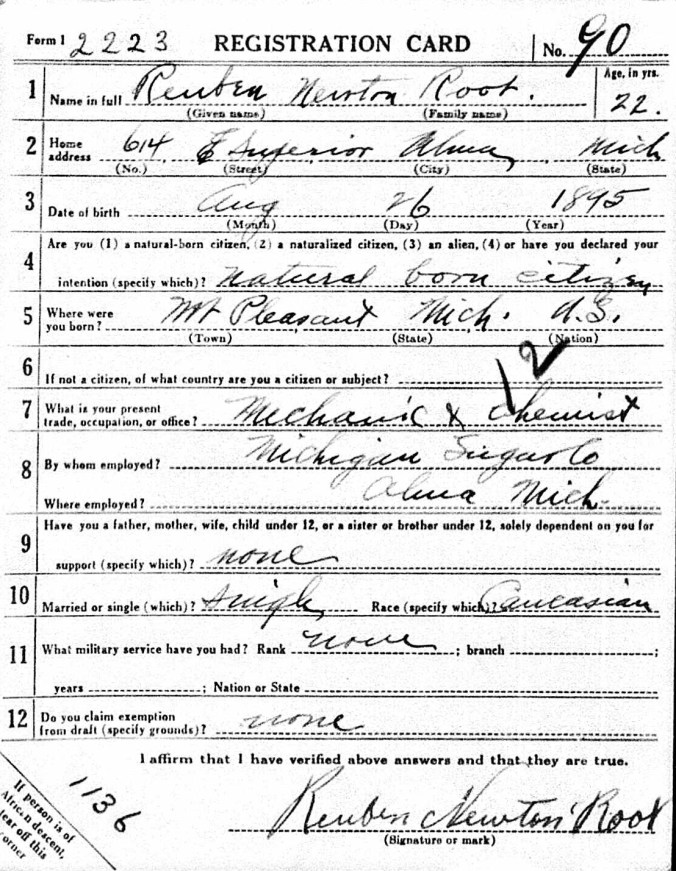
Thirty Who Dared to Serve Gratiot County in the Great War, Part 15 – Reuben Newton Root: “I came back home to serve and I died in the Flu Epidemic”

IMG_20181102_221539167.jpg76632401_1442929676.jpg005251382_01429.jpg

Above: Reuben Root’s Report of Death; his marker in Riverside Cemetery in Alma; Root’s Registration Card for Gratiot County.

       Reuben Newton Root was born on August 26, 1895, to Milton and Dora Root in Lincoln Township in Isabella County. His father was a farmer at the time. Sometime prior to 1910 Reuben Root moved to Alma and lived there when his mother remarried.   Root found work as a chemist and he took a trip with a friend to San Juan, Puerto Rico in early January 1918. Shortly before this, Root was called for an exam prior to his trip and then he was called to service only a few months later.

       Records show that Reuben returned home to Gratiot County, via  New York,  in time to enter the Army in May 1918 at Fort Sheridan. He first was a Private in Troop E of the 312th Cavalry, then he was soon promoted to Corporal in the 5th Company at the Central Machine Gun Officers training camp.

       In late September, tragedy struck. Root was at  Camp Hancock, Georgia when he was stricken by influenza and bronchial pneumonia. His date of death was September 27, 1918, and a notice of his death appeared in the Lansing State Journal three days later. He left a $10,000 insurance policy to his mother, Dora Flansburg, and his remains were shipped to Alma for burial where he rests today in Riverside Cemetery.

At his death, Ruben N. Root was only twenty-two years old.

Copyright 2018 James M Goodspeed


Gratiot Count During the Great War – October 1918: “Remaining Patriotic to the End”

IMG_20181102_212312748.jpgIMG_20181102_212301537.jpgIMG_20181102_212253366.jpg

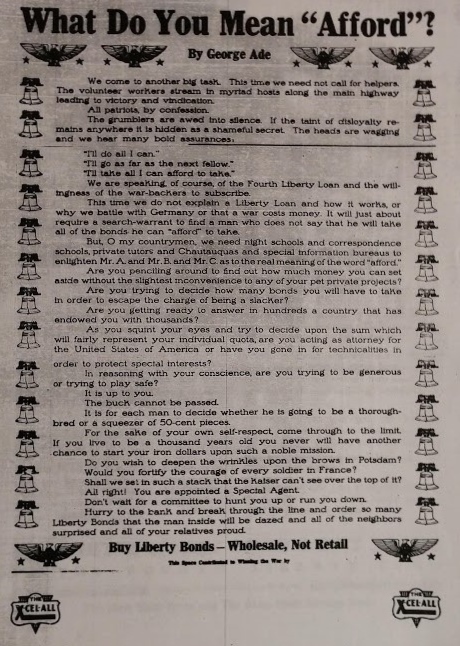
Above: Advertisements from October issues of the Alma Record.

        October 1918 in Gratiot County was known as the time of the next big Liberty Loan drive. It was announced that the Fourth Drive was most important to the winning of the war. The County War Board quickly made it known that a list of “non-buyers” of Liberty Bonds would be published in the newspapers. A Vigilance Committee was also formed to “round up slackers” who were “men of means, who are making to hide behind fifty dollar subscriptions when they should take  several times that amount.” A personal, handwritten letter from President Wilson appeared in the Alma Record telling the public why it was important to buy more bonds. Alma mayor Frances King announced that Friday, October 7 was a “Loan Holiday” in town and all businesses were closed to allow bond sellers to circulate around town and out in the countryside.  At times that October speakers appeared in various locations to whip up support. One of these took place at Alma High School’s auditorium where Dr.J.M. Magil, who once been to Germany, addressed a large crowd there. He also gave a similar speech at the Republic Truck Company.

        Advertisements urged Gratiot people to buy bonds with titles like: “There’s a Soldier Facing Death For You…BUY, BUY, BUY A BOND.” Another warned readers that “The Princes of Germany are Shaking Dice for the United States – Buy Bonds.”  Other titles were “How are You Going to Answer Germany’s Peace Terms?” and “The Enemy is Watching: Lend the Way Our Boys Fight-To Your Utmost.”  In Alma, the drive was so successful that by mid-month it was announced that the city would actually double its quota.

        Other county schools remained involved in the Liberty Loan drive as well. Down at Middleton,  a parade took place from the school down to Mertz’s Hall, where a Liberty Loan meeting was held. A similar meeting was held over at the Perrinton School.   Other locations in the county had church sponsored drives, such as in Breckenridge where $5,000 in bonds was sold at three churches. Sales over at St. Louis went so well that the city was the first precinct in the state of Michigan to “go over the top” by meeting its $40,750 goal from 694 people who volunteered to buy bonds. As a result,  St. Louis received an honor flag at a ceremony at the opera house after the thirty-piece Jackie Band from Great Lakes Naval Station entertained the audience.   Other places were also so successful to the bond drive that Alma, Ithaca and Elba Township all received their own Honor Flags as well. While all of these bond sales took place, a new idea was emerging in Gratiot County that happened over the next few years. Car dealers (and later banks) would accept Liberty Bonds and War Savings Stamps as part payment for car sales and loans.

       During that fall people were being asked to think ahead to Christmas and local men who were overseas. In early October, instructions were given regarding sending Christmas packages to the front. In order for the Red Cross to deliver a package from the family, each soldier had to fill out a label telling from whom they would like to receive a package. The Red Cross furnished specially sized boxes to residents and the box then had to be turned into the local Red Cross unit in order to be mailed.

        Five hundred soldiers rolled into Alma aboard the local trains this month in order to drive Liberty trucks overland to the East Coast. At Alma College, induction papers arrived for fifty men and they were then made members of the SATC service. More students on campus were waiting for more induction papers.

       And then there were monthly letters from soldiers abroad. L.Verne Buckborough wrote home from France about the abundance of war souvenirs that could be picked up on the battlefield. German helmets were especially prized. Glen Sergeant of Ithaca wrote home that he had been wounded twice, but he claimed to be okay after wounds to the head and his back. Harvey Brillhart described how French families drank wine like the way Americans drank coffee. However, since it had no sugar in it Brillhart would not drink the wine. E. H. Loudenbeck of Perrinton was satisfied with his $39.50 in monthly pay. Still, too many fellow soldiers were soon broke because they gambled theirs away. Although Floyd Thomas had spent time in the trenches, he had yet to catch “the cooties.” Having two cats in the trenches with his group helped to keep the mice population down. One of the most unusual of letters that month came from Miss Viola Smith, who had a sister in Ashley, and who was a Red Cross nurse in France. She wrote that Base No. 11 was “a long way from Tipperary” but it was safe there.  Working in a tent of fifty soldiers who had been gassed was especially sobering for her.

       The Red Cross kept up its work in Gratiot County. Relief for Belgium was a goal of many of the works that women did. One volunteer in Alma brought in a completely new baby’s outfit consisting of twenty articles made from fine wool. The Red Cross noted that this was donated by “a generous patriotic woman” in the community. As the flu epidemic broke out women were asked to wear face masks when they entered the workroom.  People who attended the Red Cross benefit at North Star voiced their concern about the village having its own Honor Flag and so they pitched in seven dollars toward purchasing one. Over at Newark Township, the Red Cross provided seven comforters and fifty-six articles of clothing for Belgian relief. The comforters were made in just four days with help of children from four schools in that township. Mennonites also contributed one quilt that had a log cabin on it. Attendance was growing at Newark with twenty-four workers at the previous work session.  It was also reported that the Bannister branch of the Red Cross raised nearly $500 the previous month.

        The public continued to be absorbed with the war. A War Exhibit Train arrived in the county to promote Liberty Bond sales. It was estimated that 10,000 people saw the train when it appeared in Alma with its collection of weapons and armaments from the Western Front. A hot movie that drew people to the St. Louis Liberty Theatre was “Over the Top,” a movie which depicted the life of Sergeant Arthur Guy Empey’s story of fighting on the front in France. A Liberty Day Celebration was held at the Ithaca fairgrounds on what was called a national holiday to raise money for the war effort. Farmers were encouraged to build new buildings for hogs, to store grain, or food for livestock only if improvements were necessary. Permits were not needed for construction on farms if it did not exceed $1,000 and if the farmer did not use skilled labor for a building. An Ithaca resident, Aaron Page, told of his stay in Russia before and during the revolution there. Page stated that he had worked as a driver in the Czar’s racing stables.

       October also saw a rise in the movement for women’s suffrage in Gratiot County.  Notices were placed in the newspapers by women who asked readers to vote for suffrage. A total of 280 women from Alma’s Fourth Ward signed one advertisement petitioning for votes in the state’s November 5 election. Several businessmen also donated their space in newspapers at the end of October and urged the public to support the measure.

       As October closed, rumors that the war would soon end circulated through Gratiot County, often creating celebrations that proved to be false alarms. Yet, the war would soon conclude in early November 1918.

Copyright 2018 James M Goodspeed
 

Gratiot County and the Influenza Epidemic of 1918, Part I: “It Was Unlike Anything Gratiot Had Ever Experienced Before”

IMG_20181022_212642668.jpgIMG_20181022_212732361.jpg

Above: October 1918 newspaper advertisements.

        What happened in Gratiot County in the fall of 1918 was both an epidemic and a pandemic. It was the county’s worst encounter with influenza, but it was also a worldwide problem.  In all, approximately one-quarter of all Americans got the flu, a total of 25 million people. More Americans would die from the Influenza Epidemic than did soldiers and sailors who died in the World War.

       Some people knew it as “the grippe”, a term that had been in use for the frequent waves of influenza that seemed to come seasonally to places like Gratiot County.  Others called it “The Spanish Influenza.” In the fall it was the second of three waves. The first invasion came in the spring of 1918 and left little indication of how deadly it would be. Even after the terrible events of the fall of 1918, in the spring of 1919, influenza visited again.

        It was in September 1918 that the virus reached Gratiot County and by early October many became sick. Still, life was going on and patriotism was very much in swing. The fall of 1918 saw intense Liberty Loan (bond ) sales, drives, meetings, and parades. People in Gratiot County were expected to contribute heavily to the war effort by buying bonds. There was a feeling that the war could end soon as the Germans were on the retreat in France. Loyalty and support for the war effort seemed to approach a fever pitch –and people who did not appear patriotic were noticed.  People were congregating, meeting, and working in support of the war. And they were encountering and spreading the influenza virus. The virus was here in Gratiot County and it was at work.

      For many who were victims of “the grippe ” or “Spanish Influenza”, it meant suffering through intense influenza and then succumbing to a secondary viral infection.  Usually, this came in the form of pneumonia.  Symptoms could include having a sore throat, a serious cough, experiencing muscle pains or pain in the joints, the feeling of being cold all the time, or experiencing a fever of 101-105 degrees.  For those who experienced viral pneumonia, they often had intense delirium, the coughing up of blood,   bleeding out of their nose or ears, and  even having skin turn “as blue as berries.” For some people in Gratiot County it meant feeling healthy in the morning and then being weak, confined to bed and delirious in the evening. Others described the illness as if they were being hit with a club.

     This flu epidemic in 1918 was also unique in that adults in their twenties and thirties died, leaving families and homes adrift. This was different from the past when influenza seemed to claim the very young and the very old as primary targets. People tried to counter the influenza epidemic by keeping areas of the county clean. What were they told? Keep your house clean, keep your “bowels open,” get plenty of sleep, eat a light diet and practice social distancing, which went back to the Middle Ages.

      Churches and theaters closed. Businesses closed their doors as well. “Quarantine” was the word that meant staying away from homes that had contracted influenza. Those who broke the quarantine could find themselves facing the wrath of the health department or even end up in court.

     The truth was in Gratiot County, as in countless numbers of cities and villages across the United States, no one knew how to combat the influenza virus. Doctors could not explain why some of their treatments seemed to work on some patients and failed with others.  The strain upon the community and a sense of helplessness about what to do was experienced by doctors, nurses, clergymen, health department officials, and city governments.

      In the fall of 1918, these were some of the things that Gratiot County experienced at the time called the Influenza Epidemic. It was a time in our history that our ancestors would not talk about.

Next: Part II – “And They Came and Went to Camp Custer”

Copyright 2018 James M Goodspeed

Gratiot County and the 1918 Influenza Epidemic, Prologue: Palmer Gustin Arrives in Middleton

20513822_125930287604.jpgPalmer's wallet128.jpgIMG_7860.JPGGustin induction110.jpg20513822_131989651798.jpg

Above: Photograph of Palmer Starr Gustin; Gustin’s wallet; Jim Goodspeed’s World Geography class at Fulton High School, Fall 2005 with the effects of Palmer Gustin; Gustin’s induction paper; Gustin’s grave in Indiana.

       The papers, wallet and American Flag did not appear to draw any interest. When I first saw the auction lot on eBay I was interested in the contents of the lot, and even more, intrigued that no one seemed to want it. There was only a short time left on the auction and the contents belonging to a World War I veteran from Anderson, Indiana just sat there.

        It was early 2005, the internet was buzzing, and the United States had not yet suffered its greatest recession since World War II. Items pertaining to American military history could be found on the internet and those from the World War I era, while prevalent, often did not draw that much attention. It was as if World War I was a forgotten war – and this group of items in this sale was available.

       After I won the contents of the lot and it had been delivered to my room at Fulton High School in Middleton, Michigan I wondered just what the story was behind a soldier named Private Palmer Starr Gustin. All of the contents were the remains of an estate sale and contained a slightly mildewed American flag from 1918, a billfold,  a Red Cross receipt for a $1 donation, a photograph of a girl, and a bank book. Other, more interesting items, included Gustin’s registration card, conscription letter, General Orders, names of other soldiers on a notepad, a poem about Kaiser Wilhelm and his draft board classification card. There was also a very large, oval-shaped,  “fish eye” type of photograph of a soldier that had since been removed from a frame. There was also a collection of condolence cards; one was signed “War Mothers.”

        Since I tended to be a part-time History teacher, and because I seldom got the opportunity to teach American history, I had to be creative with ways to get history into the classes that I taught. During the fall 2005 semester, I had been assigned a World Geography class. I decided that I would do the unusual: let my small group of Geography students do the detective work on the internet to see what they could find out about this collection of World War I items and just who this Palmer Gustin really was. I could argue that I was teaching the geographic theme of “movement.” Actually, I just held my breath, did not tell my administrator what we were doing on Fridays and let the students learn something about history.

         The internet in 2005 did not have all of the search engines and sites that exist today. Many museums and archives were just then coming online with access to their collections and many had just started to digitize some of their holdings. Still, I was surprised at what my students were able to find.

         It turned out that Private Gustin was the son of John and Nellie Mae Gustin and the family had lived in central Indiana for quite some time. Born in 1898, Palmer was the eldest son of five children. His only brother, Arthur, died in 2004 at the age of 97. It was also discovered that Palmer appeared before the local draft board in Madison County in August 1918 and he was sent to Camp Sheridan in Alabama. There he became a part of Company C, 67th Infantry. All of this happened after he had been rejected from the Army and Navy in 1917 and then was accepted for Selective Service in 1918. It was then that the class found out that something very bad had happened to Palmer Gustin.

         Gustin had been at Camp Sheridan for a short time in the fall of 1918 (possibly eight weeks) when the Influenza Epidemic hit the camp. Camp Sheridan was not the only camp to experience the epidemic, military cantonments (camps) across the United States had been invaded by the virus by September 1918 at the latest. Some encountered it earlier that spring. Soldiers quickly became sick with influenza, were incapacitated and then frequently suffered pneumonia, which killed them. Palmer Gustin contracted influenza and died on October 24. A week before Palmer died,  a total of 2,367 cases of influenza were reported in the camp. This young man from Indiana, age 22, was one of those who was taken in the epidemic.

         After my class tried to make sense of the puzzle that they had been given, the question was asked, “What should be done with the remaining effects of Palmer Gustin?”  The next assignment was to find out if any family members were still alive and if they could tell us anything else about this soldier. We were lucky and we discovered that there was a niece still living in the Anderson, Indiana area. Of course, Mr. Goodspeed was nominated to try and make the initial contact. I did and I found Paula Bronnenberg, who was very interested in her great uncle’s belongings and she wanted to know why a bunch of students from another state found them. Mrs. Bronnenberg helped to fill in some of the pieces of her uncle’s life. Paula lived in the same farmhouse that Palmer Gustin had been born and lived in. She knew of his death in the flu epidemic and she also knew who the girl was in one of the pictures that I described: it was her grandmother, Mattie Palmer. Mattie’s first name was on the back of the photograph.

         Bronnenberg also explained that there had been an estate sale in the family and that she had failed to obtain Great Uncle Palmer Gustin’s military items. We decided as a class that these things belonged in Indiana and we shipped them back to her. I took pictures and made copies of the items before we returned them and the file disappeared into my crowded filing system until I remembered having it some two years ago. At the time, I was starting to investigate Gratiot County in the Great War and this thing called the Influenza Epidemic.   As a teacher, my small group of Geography students had been introduced to the deadly event in history known as the Influenza Epidemic of 1918. I knew a little about this pandemic, but what really happened in Gratiot County?

            This was the next adventure.

Next time, Part II:  The Background of the 1918 Influenza Epidemic

Copyright 2018 James M Goodspeed
Fifty Years Ago – “Remembering Gratiot County’s Tiger of 1968”

Northrup game 6.JPGNorthrup country.JPGJN Day.JPGNorthurup half time.JPG

Above: Jim Northrup’s Grand Slam in Game Six of the 1968 World Series led to a 13-1 blowout of the St. Louis Cardinals and set up a crucial Game Seven, which he hit the game winner and gave the Tigers the championship; a billboard south of Alma along US-27; scenes from Jim Northrup Day, October 19, 1968 in Alma. Northrup made a personal appearance for fans, appeared in the Alma College parade and was recognized at halftime of the Alma-Albion football game in honor of “Jim Northrup Day” in Alma, St. Louis and Breckenridge.

          The sign along US-27 south of Alma read, “THIS IS NORTHUP AND TIGERS COUNTRY.” The date was October 10, 1968, and the Detroit Tigers had just won their first World Series in 23 years. At the heart of the story was a former Gratiot County native, student, and athlete named Jim Northrup.

           After finding themselves in a 3-1 deficit in the World Series, Northrup keyed a comeback in Game 6 when he hit a grand slam by teeing off on the first pitch he saw that afternoon (he hit four grand slams prior to this during the regular season). It helped the team to a 13-1 trouncing of the Cardinals and set up the final game of the series. In Game 7, Northrup broke open a close game in the 7th inning with a triple off of Cardinals great Bob Gibson. It proved to be the game-winner and the Tigers were only the fourth team in Major League history (to that point in 1968) to come back from a 3-1 deficit to win the World Series. Detroit – and Gratiot County- went bonkers.

          But, first, let us back up. Prior to the start of the World Series in October, several Gratiot County residents were cautiously optimistic that the Bengals would defeat the heavily favored Cardinals. Even after an amazing season that saw the Tigers win 104 regular season games, Gratiot County Herald columnist Harold Smaltz was the only local newspaperman to go on record to state that the Tigers would win the Series. Smaltz thought the Tigers would win it all in six games. Others around Gratiot County were interviewed by newspapers to get their opinions about the upcoming World Series. Given that the Tigers had come from behind to win 28 regular season games, all of those interviewed thought that the Tigers would triumph.

After being stopped in downtown Ithaca for an interview,  Sandy Brillhart, Nancy Goostrey, Vicki Merchant and Barb Johnson were asked for their opinion about the Tigers winning the World Series. All agreed that “They’re definitely going to win. They’ve been doing so well, they’ll win!” Postal worker Orval Shaw was stopped in front of the Ithaca Post Office where he was taking down the flag for the day. While he did not follow the Tigers as much as his wife did that summer, he thought his wife’s commitment to following the Tigers and that she stayed up late nights to watch many of their come from behind victories convinced him to believe in the Tigers, too. Former Ithaca great Roger Howes also picked the Tigers because of their bullpen, their youth, their depth and how they compared to the Cardinals player to player. Still, as the World Series played out there were plenty of moments when it seemed that the Cardinals were going to claim their second consecutive World Series Championship, especially after being up 3-1 over Detroit.

         However, after the dramatic Game Seven win, there were plenty of Jim Northrup supporters in Gratiot County. Northup’s’ high school coach,   Levatt Caszatt, who was principal at St. Louis High School, commented that the “come from behind character” of the Tigers in the World Series was very much the temperament and character of Jim Northrup as a high school player and Alma College athlete. Caszatt remembered that while Northrup was not the player with the most ability on the St. Louis football, basketball or baseball teams that Caszatt coached, he had “a tremendous spirit” and Northrup became an excellent trainer. Alma College coach Art Smith recruited Northup to play football, golf, and baseball at Alma College. As Northrup’s mentor, he knew Jim had determination, that he was aggressive and he always gave 100 percent. Smith stated after the World Series, “ I always thought he was a big leaguer.” Dr. Lester Eyer also recalled the challenges Northrup had as an Alma College student when deciding whether to pursue a career in the medical field or to become a professional baseball player. Eyer stated, “It was a big decision for him to make, between medicine and baseball. We’ve been real proud of him for what he’s done the last two days.”  Fortunately for Detroit and Gratiot County that October,  that is what Northrup eventually became, a world champion.

         In recalling the afternoon that the Tigers won Game Seven of the World Series (at that time all World Series games were being played in the afternoon, not evenings), people celebrated in their own way. While cutting hair, Alma barber George Clark almost cut off the ear of the man whose hair he was cutting.  When the go-ahead run was reported over the radio in Game 7, the man jumped up out of the chair and Clark recalled that he almost got the ear in the process.  One young Alma wife could not locate her husband until very late that evening. She expected him home for dinner and when the husband came in late from the bar that night, he explained that he was out celebrating with the boys about the Tigers winning it all. Regardless, she gave her husband a cold dinner. Sometimes for some people in Gratiot County, the hardest part of the Series was just following it. As already stated, these were day games and for some like one unnamed Alma High School student, he lamented to a local newspaper that teachers seldom let students listen to the games. Yet, during Game Seven he found one teacher who had a radio and listened to the action. The problem was that class ended before Northrup’s triple occurred and the scoring really started. Other students remembered getting home from school, or from off of the bus, to hear that the Tigers had just won Game Seven.

          There were many well-deserved accolades for this team of World Championship Tigers in 1968, but Gratiot County remembered just one of them. One of the headlines the day after the win read “Northrup’s hit gives Tigers the Series.” A large billboard sign located on the northbound part of US- 27 south of Alma read in bold letters “THIS IS NORTHRUP AND TIGERS COUNTRY.” Later that month, Northrup was honored at Alma College’s Homecoming parade in what was also recognized as “Jim Northrup Day” in Alma, St. Louis and Breckenridge. During the parade, he road atop a white convertible. A large banner in downtown Alma near City Hall read: “Jim Northrup and Alma Alumni…Welcome to Alma—Scotland USA.” Northrup was also recognized at halftime of the Alma-Adrian football game and he crowned Alma College Homecoming Queen Kathy Richards. Prior to the festivities that morning, Northrup appeared at Alma Plumbing and Heating to sign autographs and pose with fans for pictures.

          One news column that ran in the Alma Record-Leader after the World Series  was entitled “A Place in Heaven?” It stated that in Gratiot County, “This is Northrup country. And Lolich country, and Kaline, and Cash Country. But mostly Northrup country.” It also concluded “that all good ballplayers, like good Christians go to heaven. But that shouldn’t be a surprise to Jim (Northrup). That’s Northrup country too.”

         That October of 1968 in Gratiot County remains a slice of heaven that Detroit Tigers fans have never forgotten, even fifty years later – and a Tigers player and local native named Jim Northrup.

Copyright 2018 James M Goodspeed